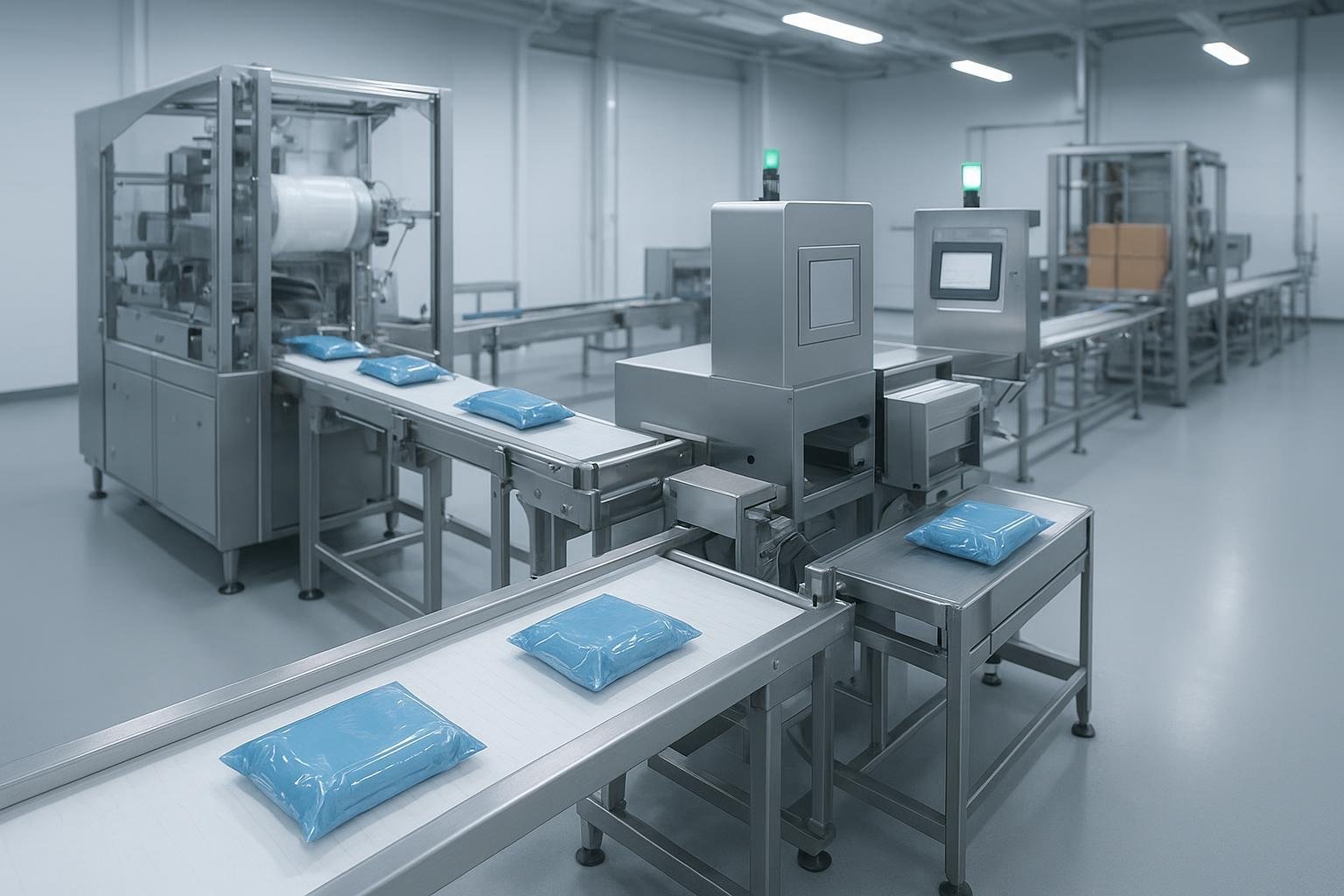
If you diagram a food packaging line from the first sealed pack to the pallet, conveyors are the backbone that keep every station in sync. The trick isn’t just moving things from A to B—it’s doing it hygienically, repeatably, and with enough control to index, merge, inspect, reject, and accumulate as needed. Below is a single, station-by-station map of where conveyor belts show up in food packaging, what types are common, and the hygiene features that actually matter.
Where belts appear, station by station
-
Product infeed and singulation — Primary
- Purpose: Deliver individual items or containers to the filler, wrapper, or former at a controlled pitch.
- Common belt types: Modular plastic (flush grid), low‑tension PU belts, tabletop/MatTop chain for rigid containers.
- What to watch: Gentle handling, guides for container stability, washdown‑friendly construction.
- Evidence: Industry directories document modular and tabletop conveyors as standard choices for infeed/discharge and container control on food lines (PMMI ProSource, 2022–2025) — see the overview for modular conveyors used in packaging lines.
-
Take‑away from HFFS/VFFS/flow wrappers — Primary
- Purpose: Remove sealed packs cleanly, stabilize flow, and transfer to accumulation or inspection.
- Common belt types: Modular plastic with good release, positive‑drive hygienic PU/TPE belts, low‑profile sanitary frames.
- What to watch: Belt surface release for sticky packs, drip/drain features, quick belt change for sanitation.
- Evidence: Sanitary platforms emphasize easy‑to‑clean designs for wrapper discharges and frequent‑wash zones (Dorner, 2023) — Dorner sanitary conveyors blog archive.
-
Indexing and spacing conveyors — Primary
- Purpose: Create consistent gaps for printers, vision systems, checkweighers, and cartoners.
- Common belt types: Low‑slip PU belts with VFDs; modular belts with friction‑top surfaces.
- What to watch: Speed matching with upstream equipment, transfer geometry to avoid jams, accumulation‑friendly controls.
- Evidence: Infeed/discharge categories highlight timing and back‑pressure management on packaging lines (PMMI ProSource, 2022–2025) — infeed and discharge conveyors overview.
-
Incline and cleated transfers — Primary
- Purpose: Elevate pouches, bars, or small packs to higher decks or mezzanines.
- Common belt types: Cleated PU belts, modular plastic with flights; Z‑incline frames.
- What to watch: Cleat height/pitch for product geometry, side skirts for containment, self‑draining frames for washdown.
- Evidence: Washdown vertical transport solutions stress self‑draining frames to speed sanitation (Nercon, 2025) — Nercon washdown spiral overview.
-
Metal detector conveyors — Inspection & QA
- Purpose: Detect ferrous and non‑ferrous contaminants and reject nonconforming packs.
- Common belt types: Food‑grade PU or modular belts with non‑metallic components in the aperture zone.
- What to watch: Metal‑free area around the aperture, aperture sizing relative to product, synchronized reject (air blast, arm, pusher), hygienic frame.
- Evidence: Conveyorized systems integrate detection heads, belts, and reject devices with sanitary designs for packaging (METTLER TOLEDO Safeline, 2022–2024) — conveyor metal detection systems for packaged foods.
-
Checkweigher conveyors — Inspection & QA
- Purpose: Dynamically verify package weights and automatically remove off‑weight items.
- Common belt types: Smooth, dimensionally stable, food‑grade belts; dedicated infeed/weigh/outfeed sections.
- What to watch: Consistent spacing, precise speed control, reject selection based on package form; hygienic cleanability of weigh decks and guards.
- Evidence: Industry guidance outlines synchronized conveyors and multiple reject mechanisms (Heat and Control, 2022) — checkweigher rejector options: flip, fall, or fly. See also METTLER TOLEDO’s food checkweighing page for system context (2022–2024) — food checkweigher systems.
-
X‑ray inspection conveyors — Inspection & QA
- Purpose: Detect dense foreign material in sealed or boxed products.
- Common belt types: Low‑attenuation belts that don’t compromise imaging; consistent singulation.
- What to watch: Shielding integration, reject verification, belt material compatibility with cleaning chemicals.
- Evidence: X‑ray system makers specify belt and hygiene practices similar to metal detectors and checkweighers; for example, Anritsu and METTLER TOLEDO publish packaging X‑ray configurations with cleanable conveyors and synchronized reject. See METTLER TOLEDO’s packaging X‑ray info (2023) — X‑ray inspection for packaged foods.
-
Cartoner infeed and outfeed — Secondary
- Purpose: Transfer primary packs into, through, and out of cartoners; often with lanes or collators.
- Common belt types: Tabletop/MatTop chains, modular plastic with adjustable guides.
- What to watch: Gentle merges/diverts, tool‑less guide changes for SKUs, sanitary frames near food‑contact areas.
- Evidence: Modular and tabletop conveyors are staples around cartoners and multipackers (PMMI ProSource, 2022–2025) — see tabletop conveyors for packaging.
-
Case packer infeed, combiners, and diverters — Secondary
- Purpose: Merge lanes, align product flow, and meter into case packers.
- Common belt types: Modular belts, metering belts, servo‑driven diverters/combiners.
- What to watch: Accumulation strategy (mass‑flow vs. FIFO), simple changeovers, hygienic guides.
- Evidence: Packaging sources emphasize tool‑less guide adjustments and hygienic construction around these operations (PMMI ProSource, 2022–2025) — see the infeed and discharge conveyors overview.
-
Accumulation tables and buffers — Secondary
- Purpose: Absorb micro‑stoppages so upstream doesn’t starve, or provide manual pack‑off space.
- Common equipment: Rotary accumulation tables, mass‑flow spirals, FIFO zero‑pressure conveyors.
- What to watch: Package stability, footprint, order preservation, clean design for washdown.
- Evidence: Spiral conveyors provide compact vertical accumulation with high throughput in food and beverage packaging (Ryson, 2025) — advantages of spirals in food and beverage conveying.
- Print‑and‑apply labeler conveyors — Secondary
- Purpose: Present cases, trays, or packs to labelers and printers at consistent pitch and height.
- Common belt types: Smooth belts with encoder feedback; roller or belt‑over‑roller for cases.
- What to watch: IP69K/NEMA 4X labeler enclosures in washdown, adjustable guides, guarding around print heads, cleanable surfaces for ink/adhesive.
- Evidence: Hygienic labelers are designed to IP69K and exceed IP66/NEMA 4X for washdown environments (MFT Automation, 2022–2024) — hygienic labeler design.
- Case taper/sealer outfeed and conveyor to palletizer — End‑of‑line
- Purpose: Move sealed cases from tapers/erectors/sealers toward palletizing with controlled accumulation.
- Common belt types: Belt‑over‑roller, roller, or MatTop chains for robust case handling.
- What to watch: Transfers that avoid case catching, accumulation controls, stainless construction near wet areas.
- Evidence: Case handling frequently uses modular/tabletop or roller platforms in packaging lines, with sanitary options available (PMMI ProSource, 2022–2025) — see tabletop conveyors for packaging.
- Palletizer infeed and right‑angle transfers — End‑of‑line
- Purpose: Present cases at the correct pitch and orientation for pattern forming and layer building.
- Common belt types: Chain‑driven live roller (CDLR), belt‑driven live roller (BDLR), MatTop for accumulation, and 90‑degree belt transfers.
- What to watch: Merges/diverts, metering conveyors, end‑of‑arm reach envelopes, guarding.
- Evidence: Integrators describe coordinated infeed conveyors that meter and orient cases before robotic palletizing (MESH Automation, 2023) — case packer and palletizer systems overview.
- Pack‑off tables and takeaway belts for small packets — End‑of‑line
- Purpose: Accumulate small pouches or bars for manual case packing, or transfer to case packers.
- Common belt types: Narrow belt conveyors feeding rotary pack‑off tables; stainless, adjustable features.
- What to watch: Gentle handling to avoid crushing, variable speed for ergonomics, simple cleanup.
- Evidence: Suppliers provide packet takeaway belts and pack‑off tables for snack and small‑package environments, highlighting stainless builds and adjustability (KMG Systems, 2022–2023) — packet takeaway belt conveyors.
Hygienic design fundamentals you’ll apply repeatedly
Open, cleanable structures and tool‑less disassembly speed sanitation and reduce harborage. One well‑known platform for food processing and packaging highlights compliance with recognized sanitary programs and tool‑less removal of belts and components to cut cleaning time (Dynamic Conveyor, 2023–2025) — food processing and packaging conveyors.
In wet zones, specify washdown‑rated electricals. Manufacturers note the use of NEMA 4X and, in some cases, IP69K for high‑pressure, high‑temperature washdowns; controls offerings for sanitary lines explicitly call out these ratings (Dorner, 2023) — controls solutions with NEMA/IP guidance. IP ratings context is summarized by industry explainers (Hanover Conveying, 2023) — understanding IP ratings for washdown conveyors.
Selecting the right belt material is as much about sanitation as it is about traction and product release. Think of it this way: the wrong material might look fine on day one but can degrade fast under your sanitizer chemistry or leave you fighting sticky residue every shift.
| Belt material | Typical use in packaging | Sanitation and handling notes |
|---|---|---|
| PU/TPU flat belt | Primary‑pack takeaways, indexing, label/print presentation | Smooth surface for easy cleaning and good release of sticky packs; inspect chemical compatibility with your cleaning agents and concentrations. |
| Modular plastic (PP/PE/Acetal) | Infeed/outfeed, elevation with flights, accumulation | Open area for drainage and easy module repair; select resin for temperature/chemical exposure; avoid excessive flat ledges. |
| Tabletop/MatTop chain | Rigid containers, cartoners, case handling | Durable and accumulation‑friendly; choose materials and lubrication suited to washdown or dry running. |
For compatibility and longevity, belt makers emphasize matching sanitizer chemistry and concentration to the specific resin family to extend belt life in food applications (Intralox, 2022–2024) — food industry materials and compatibility notes.
Practical tips that pay off in uptime
- Design transfers to fit your smallest SKU. If a fragile bar can bridge a gap, expect jams.
- Use lift‑up or quick‑release features where crews need to see and clean under the carryway. Tool‑less components shorten sanitation windows.
- Align inspection conveyors with the controls strategy. Spacing and speed matter more than most teams expect.
- In mixed wet/dry zones, choose enclosure ratings intentionally; NEMA 4X and IP69K aren’t interchangeable badges—tie them to your washdown method and SOPs.
Wrapping up Conveyor belts show up everywhere in food packaging because they do far more than transport—they meter, merge, elevate, inspect, reject, and buffer, all while withstanding caustic washdowns and tight changeovers. If you’re scoping a new line or a retrofit, start with the stations above and pressure‑test each choice against cleanability, inspection integration, and your sanitation chemistry.
If you’d like help evaluating belt types and component choices for harsh or abrasive environments connected to your packaging operations, you can contact our team. Disclosure: BisonConvey is our product — بيسونكونفي.