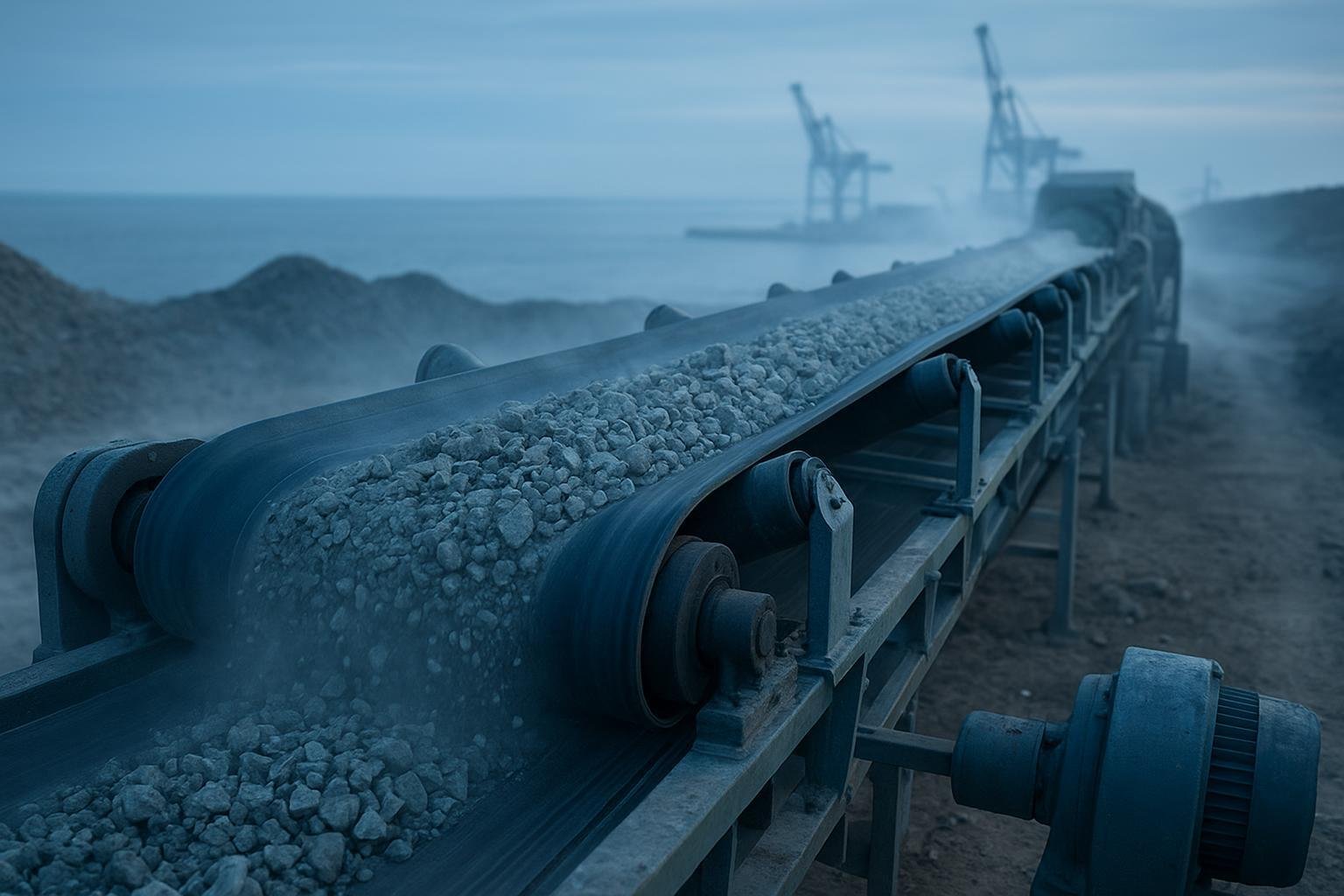
Ports and quarries punish conveyor systems. Sharp, abrasive aggregates and heavy, irregular loading at transfer points combine with weather, moisture, and long outdoor runs. In this environment, a well-specified fabric conveyor belt can deliver high availability—provided you engineer for the dominant failure modes and validate splice quality.
This ultimate guide focuses on what matters in the field: preventing failures in abrasive, high-impact service and knowing when a fabric conveyor belt beats steel-cord for ports and quarries. You’ll find standards-backed selection cues, transfer-point engineering practices, splice QA tactics, and maintenance routines that keep belts on track and plants running.
Standards primer for fabric belts
Standards anchor specifications and help you read data sheets without guesswork.
ISO 14890 defines the specification scope for rubber- or plastics-covered textile belts for general use (dimensions, tensile properties, adhesion, abrasion-related references). See the public catalogue summary in the ISO library: the entry for ISO 14890:2013 describes the framework and referenced methods. Source: the ISO catalogue for ISO 14890:2013.
Reference: According to the descriptive entry for ISO 14890:2013 in the ISO catalogue, the standard specifies requirements for textile-construction belts and references key test methods. Consult the standard for details: ISO 14890:2013 catalogue page.
ISO 283 is the full-thickness tensile and elongation method used to determine longitudinal breaking strength and elongation at break/reference load. It’s the method, not a pass/fail spec. See the standard’s summary: ISO 283:2023 and the overview on ConveyorBeltGuide standards.
ISO 9856 separates elastic vs permanent elongation via cyclic loading to derive elastic modulus—vital for tensioning and take-up travel on EP/NN belts. See the ISO ICS index and testing overviews: ISO ICS 53.040.20 index و ConveyorBeltGuide testing overview.
ISO 4649 specifies rotating-drum abrasion testing with results reported as volume loss (mm³). Lower loss indicates better abrasion resistance, but lab numbers don’t linearly predict field life. See ISO 4649 and Dunlop’s explainer on abrasion classes and interpretations: Dunlop abrasion standards and test methods.
ISO 284 and ISO 340 cover antistatic electrical resistance and laboratory-scale flammability behavior. Apply them based on your dust/explosion risk assessment; confirm certifications per model. See ISO 284 و ISO 340:2022 (also summarized via ConveyorBeltGuide standards).
DIN 22102 defines abrasion-resistant cover grades Y, W, X commonly used in Europe. Public explainers outline how these relate qualitatively to EN ISO abrasion classes H, D, L (numeric thresholds sit inside the paid standards). See Dunlop’s explainer: Abrasion standards and test methods and the ConveyorBeltGuide testing page.
DIN 22110 and DIN 22101 shape splice reliability in design: the former for dynamic splice testing (Wöhler curves), the latter for incorporating dynamic splice efficiency in ratings and power calculations. See ConveyorBeltGuide on splice testing و standards overview.
How to use this in practice
Anchor your specification in ISO 14890 with explicit test method references (ISO 283, ISO 9856, ISO 4649).
For safety, validate whether ISO 284 (antistatic) and ISO 340 (flammability) apply to your site, especially in coal/combustible dust terminals.
Select abrasion classes using DIN 22102 or EN ISO guidance, then corroborate with supplier test results to ISO 4649.
Carcass and cover engineering: EP vs NN and abrasion classes
A fabric conveyor belt uses textile plies to achieve strength and flexibility. Two carcass families dominate heavy industry:
EP (polyester warp, nylon weft): low longitudinal stretch, good transverse flexibility, lower moisture uptake, and broad availability. See the designation notes and technical rationale in ConveyorBeltGuide’s designation explainer and Fenner Dunlop’s discussion of carcass behavior: Why the difference?.
NN (nylon warp and weft): typically higher elongation and moisture absorption than EP, with toughness that can help in severe impact zones. Datasheet definitions vary by region (NN vs PN), so confirm the supplier’s terminology.
Cover compounds and abrasion classes
For ports/quarries, severe abrasion with sharp stone is common. Use abrasion-resistant covers aligned to DIN 22102 X/W/Y or EN ISO H/D/L and match thickness to impact and wear expectations.
ISO 4649 abrasion loss (mm³) is useful for comparison between compounds. Dunlop’s technical explainer provides context for interpreting mm³ values while cautioning against direct life predictions: Dunlop abrasion explainer.
Where edge contact is frequent (e.g., tight transitions or occasional mistracking), molded edges can reduce wicking and edge fray compared to cut edges.
Environmental nuances
Temperature: Elevated material or ambient temperatures can increase elongation and soften covers. Specify heat-resistant compounds when required and plan take-up travel accordingly.
Moisture and corrosion: Outdoor terminals demand compounds that resist hydrolysis and moisture ingress; EP typically helps with dimensional stability.
Failure modes and how to prevent them in ports and quarries
Mistracking and edge wear Mistracking accelerates edge wear, raises friction and heat, and causes spillage. Root causes include misaligned idlers or pulleys, uneven loading, carryback on rollers, lagging contamination, or poor splice tracking. Countermeasures: alignment audits, cleaner housekeeping, correct tensioning, guide rollers where appropriate, and early-run thermal checks to spot hot spots. See troubleshooting insights from PROK, Luff Industries, and Redline Systems.
Impact tears and transfer-point abuse Large lumps and sharp aggregates can cut covers and carcass, especially where drop height is high or support is discontinuous. Engineer the chute to match entry velocity and direction, minimize drop height, and provide continuous belt support in the loading zone with impact beds/cradles sized to the duty. References: Martin Engineering’s Foundations (belt loading) و dust/velocity control chapters; also see CEMA accessory committee materials: CEMA meeting set.
Carryback and buildup Carryback increases friction, leads to mistracking, and accelerates wear. Prevention hinges on proper primary/secondary cleaners matched to belt width/speed/compound, plus regular cleaning of buildup-prone areas. Foundations provides selection and setup guidance: Foundations cleaner guidance.
Slippage at the drive pulley Slippage comes from incorrect tension, worn or smooth lagging, contamination, or insufficient wrap. Maintain correct tension (instrumented checks where possible), renew lagging (ceramic lagging for high-slip risk), keep surfaces clean, and ensure proper wrap. Useful primers: Redline on tension checks و Luff maintenance tips.
Splice reliability Poor splices drive early failures and tracking issues. Hot vulcanized step splices on EP/NN typically deliver the best static and dynamic strength when procedures are followed. Validate performance using dynamic testing concepts from DIN 22110; design assumptions in DIN 22101 consider dynamic splice efficiency more realistically than legacy high safety factors. References: ConveyorBeltGuide on textile splices و splice testing.
Transfer-point and impact engineering essentials
At ports and quarries, the transfer is where belts live or die. Three principles prevent most damage:
Match velocities and direction. Align the material stream’s speed and direction with the receiving belt to minimize relative velocity at impact. This reduces shock, spillage, and dust generation.
Minimize drop height. Lower drops reduce impact energy on covers and carcass.
Provide continuous support. Use impact beds or cradles sized per duty and compatible with idler class. Tighten idler spacing in the load zone to control sag and preserve skirtboard sealing.
Detailed practices—like DEM-modeled chutes and dust suppression—are documented by Martin Engineering’s Foundations program: loading zone design و velocity/dust control; accessory selection conventions are noted in CEMA materials.
Pulley diameters and transitions for EP belts
Minimum pulley diameter depends on carcass construction and thickness. Always consult the datasheet for the specific belt you select. The following examples from Fenner Dunlop illustrate typical scales (drive A / tail-bend B / snub C):
Belt (example construction) | A (Drive) | B (Tail/Bend) | C (Snub) | Source |
|---|---|---|---|---|
Superfort S 250/2 (~2.2 mm carcass) | 200 mm | 160 mm | 125 mm | |
Superfort S 400/2 (~2.6 mm) | 315 mm | 250 mm | 200 mm | |
Superfort S 1250/4 (~6.4 mm) | 800 mm | 630 mm | 500 mm | |
Trioflex T 400/3 (~4.5 mm) | 400 mm | 315 mm | 250 mm | |
Trioflex T 1250/3 (~7.0 mm) | 1000 mm | 800 mm | 630 mm |
A quick heuristic noted by ConveyorBeltGuide estimates minimum pulley diameter from carcass thickness (for EP belts) using an approximate factor, then rounding up to a standard size—useful for early concept design, but confirm with the chosen supplier: engineering heuristic.
Transition distances should be checked to avoid edge overload and splice stress; Foundations discusses profile transitions and sealing geometry in relation to sag and support: Foundations cleaner/transition notes.
When a Fabric Conveyor Belt Outperforms Steel-Cord
Fabric belts (EP/NN) excel in many port and quarry conveyors where the dominant risks are abrasion at transfer points and intermittent high impacts rather than sustained ultra-high tension over many kilometers.
Indicators that a fabric conveyor belt is the better choice
Layout involves multiple transitions and smaller pulleys, favoring the flexibility of multi-ply fabric carcasses.
Conveyors are short-to-medium length with moderate tensions, making steel-cord’s low stretch less decisive.
Maintenance strategy relies on quick field repairs and hot splicing without specialized equipment, reducing downtime risk.
The cost of ownership is driven by wear at transfer points and cleaning, not by absolute tensile utilization.
Balanced view with sources
Overviews of belt selection by length/tension and comparisons of constructions highlight where each shines; see West River’s mining belt comparison and a common manufacturer perspective on steel-cord vs fabric: comparative explainer.
Caution: Avoid hard “cutoffs” without a detailed design study. Instead, tie the decision to layout constraints, tension calculations, splice strategy, and failure-mode prevalence.
Selection and specification checklist for ports and quarries
Start from the failure modes you need to suppress, then specify the belt and the surrounding hardware to make those failures unlikely.
Carcass and covers
Choose EP for lower stretch and dimensional stability across long outdoor runs; consider NN or EP with breaker plies for severe impact zones.
Select abrasion-resistant covers (DIN 22102 X/W/Y or EN ISO H/D/L) and size the top cover thickness for both wear and impact. If edge contact is common, specify molded edges. Where heat or warm aggregates are present, select heat-resistant compounds and confirm temperature limits on the data sheet.
Transfers and support
Engineer chutes to match velocity and direction, minimize drop height, and maintain a cohesive stream. Use impact beds/cradles with idler class and spacing set to limit sag under peak load.
Power and traction
Confirm wrap angles, lagging type (rubber vs ceramic), and tensioning capacity. Plan for contamination control to maintain friction.
Splice method and QA
Prefer hot vulcanized step splices for EP/NN. Enforce SOPs: alignment, ply steps, skim thickness, cure time/temperature/pressure, and post-cure inspection. Where possible, validate via dynamic concepts from DIN 22110 and design per DIN 22101.
Safety and compliance
Apply ISO 284 (antistatic) and ISO 340 (flammability) where your risk assessment indicates; confirm certifications on the exact belt model and document in the spec.
Procurement notes
Request supplier data for ISO 283 tensile/elongation, ISO 9856 modulus/elongation components, and ISO 4649 abrasion loss, plus minimum pulley diameter tables for the exact construction.
Disclosure: BisonConvey is our product. In ports and quarries, EP and NN ranges (e.g., EP100–EP400 and NN100–NN400) with multiple cover options are commonly specified; for a general overview of the portfolio, see بيسونكونفي. This reference is informational only; confirm final specs and certifications with your chosen supplier.
To help you action the above, here’s a compact, single-level list of critical inclusions for the purchase specification:
Belt designation (e.g., EP 1000/4, 6+3 mm; molded edges), cover grade (DIN X or EN ISO H), and compound requirements (heat, oil, etc., if applicable).
Required test reporting: ISO 283, ISO 9856, ISO 4649 results; antistatic (ISO 284) and flammability (ISO 340) if required by risk assessment.
Minimum pulley diameters and transition distances for the exact construction; chute/impact bed parameters and idler spacing in the load zone.
Splice method (hot vulcanized step), SOP references, QA checkpoints, and acceptance criteria (visual, dimensional, optional verification pulls).
Maintenance playbook essentials
Routine inspection cadence keeps small issues from becoming belt failures. Focus areas:
Idler health and alignment: Replace seized or rough-running rollers; verify alignment and trough angles; look for heat marks on edges as early mistracking warnings. See maintenance primers from Luff Industries.
Cleaning and carryback control: Keep primary and secondary cleaners tuned and compatible with your compound and speed; inspect for buildup under return idlers and at pulleys. Foundations provides setup guidance: cleaner selection/maintenance.
Lagging condition and traction: Inspect lagging for glazing, cracks, or tile loss (ceramic). Renew before slip damages covers and heats the carcass.
Splice condition: Look for cracks at steps, localized swelling, or tracking offsets. Post-maintenance, consider thermal scans during commissioning to reveal friction hot spots.
Tension and take-up travel: Verify against design; temperature swings and humidity can change elongation, especially on NN or multi-layer constructions.
FAQs
Q: EP vs NN for high-impact loading at a quarry primary crusher? A: EP offers lower stretch and good stability on long runs; NN (or EP with breaker plies) can absorb impact better. Pair the carcass choice with impact beds, reduced drop height, and robust covers to address the root cause.
Q: When should I step up top cover thickness? A: When transfer-point wear dominates failure history, when drop height can’t be reduced further, or when material has sharp edges. Validate with abrasion data to ISO 4649 and consider DIN X or EN ISO H/D classes.
Q: What are early signs a fabric splice is failing? A: Tracking drift localized at the splice, visible line at the step overlaps, rubber cracks or voids at the edges, and recurring temperature rise near the splice under load. Use a visual and thermal inspection regime after any splice work.
Glossary and standards quick reference
EP conveyor belt: Polyester warp / nylon weft textile carcass; lower longitudinal elongation; common in ports/quarries.
NN conveyor belt: Nylon warp and weft; higher elongation and moisture absorption; tough and flexible for severe impact zones.
ISO 14890: Specification framework for textile conveyor belts (general use) with referenced test methods.
ISO 283: Full-thickness tensile and elongation test method for textile belts.
ISO 9856: Method to determine elastic and permanent elongation and elastic modulus under cyclic loading.
ISO 4649: Abrasion resistance test; results in mm³ volume loss (lower is better).
ISO 284: Antistatic electrical resistance specification and test method.
ISO 340: Laboratory-scale flammability test for conveyor belts.
DIN 22102: Abrasion-resistant cover grades Y, W, X; widely used in Europe for abrasion-centric service.
DIN 22110 / DIN 22101: Dynamic splice testing and design rules incorporating splice efficiency.
Closing: prevention first, then specification depth
Ports and quarries damage belts through abrasion, impact, and tracking stress—mostly at transfers. A prevention-first mindset, grounded in standards and field-proven practices, lets a fabric conveyor belt deliver high availability with manageable TCO. Where runs are short-to-medium, pulleys are modest, and rapid repairability matters, fabric often beats steel-cord. Tie your decision to layout, tension, splice strategy, and failure-mode data—and always verify details against the relevant ISO/DIN standards and your supplier’s datasheets.