If you’ve ever unwrapped a belt that spent a few months in a damp corner only to find hardened covers or rust-stained cords, you know storage can make or break service life. This guide distills conveyor belt storage best practices into actionable specs you can hand to the warehouse team—environmental targets, safe handling, conditioning after cold storage, and component storage for idlers and pulleys—plus three checklists you can print and use today.
Environment targets that actually prevent damage
For rubber and PU belts, the storage room matters more than most people think. Targets below come from rubber-storage norms (DIN 7716), belt OEM practice, and ISO guidance. These are the foundation of conveyor belt storage best practices at any site.
| Control | Target range | Why it matters |
|---|---|---|
| Temperature | 50–68°F (10–20°C) ideal; 59–77°F (15–25°C) acceptable; avoid prolonged <32°F (0°C) or >86°F (30°C) | Keeps rubber flexible and slows aging; extreme cold embrittles, heat accelerates oxidation |
| Relative humidity | Keep below ~65% RH; dry, non‑condensing | Limits moisture ingress and corrosion risk (steel cords, pulleys, bearings) |
| Light | No direct sun; block UV | UV cracks, chalks, and oxidizes covers |
| Ozone | Keep away from ozone sources (motors, welding, combustion) | Ozone attacks elastomer chains, causing surface checking |
| Contamination | Clean, dust‑controlled; no oils/solvents | Hydrocarbons swell or soften covers and edges |
According to the Semperit summary of DIN 7716 (2025), cool storage and RH under 65% are baseline conditions for elastomers, with UV/ozone avoidance called out explicitly in the standard family. See the concise industrial guidance in the Semperit technical page on rubber storage: DIN 7716 storage principles for elastomers. For belts specifically, ISO 5285 defines the scope for storage and handling; OEMs echo these ranges and procedures in practice, as noted on the standard’s page: ISO 5285 — Conveyor belts: Guidelines for storage and handling.
Safe handling and storage methods (belts)
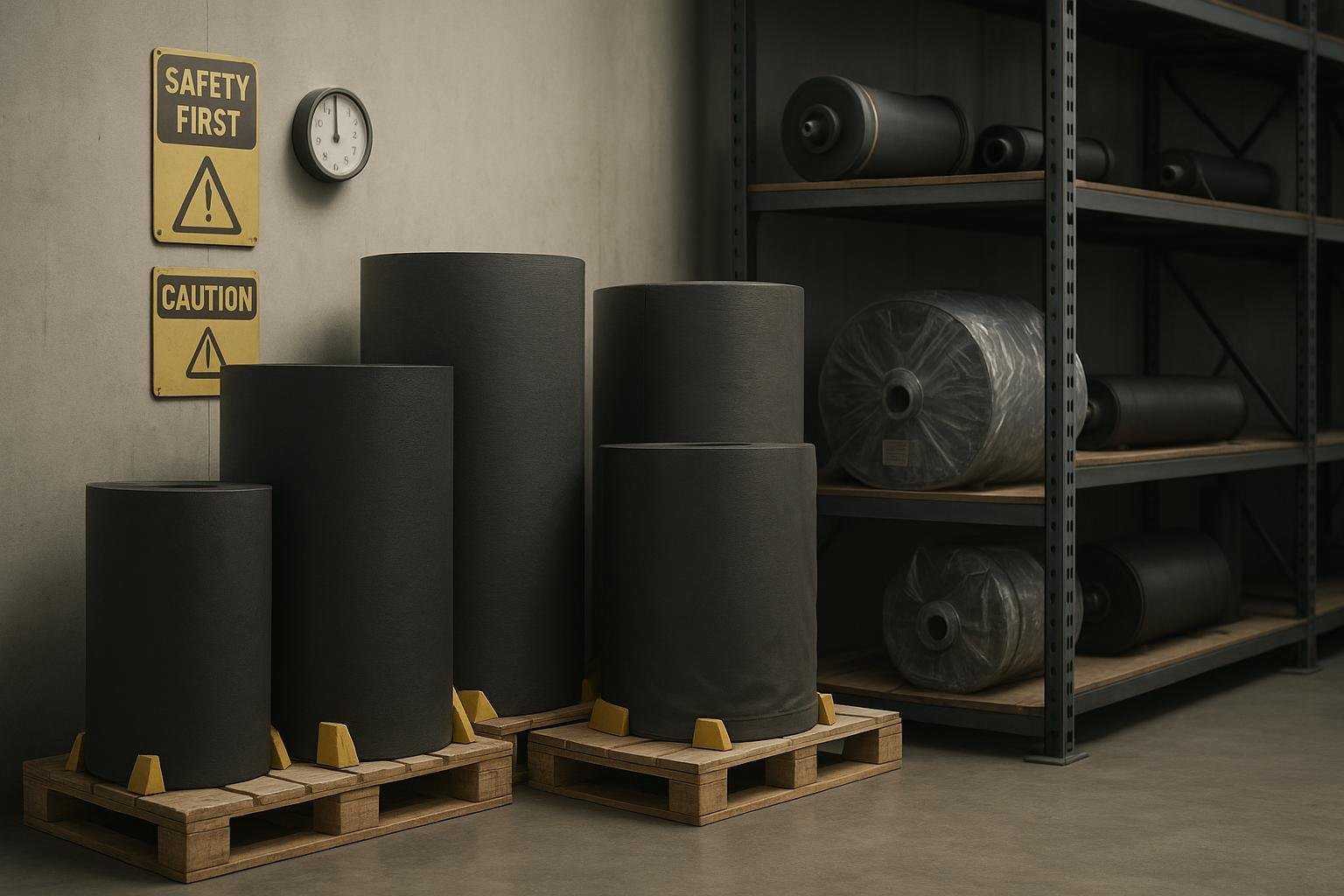
Store rolls upright on stands or pallets, chocked so nothing can creep. Don’t lay rolls on their sides; you’ll deform edges. Keep edges off the floor and keep factory wrap intact. For lifting, run a rated bar through the core and use a spreader. Avoid sharp slings against belt edges; add edge protectors when needed. When coiling or re‑reeling, use a conservative proxy: respect the belt’s minimum operational pulley diameter for its tension class rather than tightening to a smaller reel—this avoids cover cracking and ply stress.
If you want a consolidated OEM perspective on these basics, Fenner Dunlop’s handling note lays out do’s and don’ts clearly (2023): review the practical tips in the Fenner Dunlop guide to belt handling and storage. For your own teams, host a one‑page SOP near the receiving dock and the storage aisle.
For additional procedural detail, see the (Knowledge Base Source) BisonConvey handling instructions for conveyor belts.
Receiving checklist (print and stick by the dock)
- Confirm roll ID, belt type, width/strength, and lot match the PO; record received temperature and visible RH reading.
- Inspect packaging: intact wrap, dry ends, no punctures or torn film; rewrap if compromised.
- Check surfaces you can see: no chalking, cracking, or contamination; edges not scuffed or flattened.
- Verify storage path is clear: stands/pallets ready, chocks present; UV‑blocking covers available if near windows.
- If ambient or belt core temperature is below ~50°F (10°C), tag for conditioning before any uncoiling.
Conditioning after cold storage
Cold‑stiff belts are easier to damage. If a belt was stored or transported in freezing conditions, park it indoors until it warms through the core before any unrolling or splicing. A practical rule echoed by OEMs: condition for at least 24 hours at or above 50°F (10°C) to restore flexibility. Flex a short edge by hand once it’s warmed; you’re looking for smooth bending without fine surface checking. Martin Engineering’s storage tip sheet supports the same spirit—dry, temperate rooms and patient conditioning reduce installation defects; see the practical overview in Martin Engineering’s belt storage and handling tips.
Idler and pulley storage: protect bearings and surfaces
Treat idlers and pulleys like precision parts. Keep them in original packaging on shelves or pallets, away from vibration and concrete floors. Aim for roughly 68°F (20°C) and RH below ~60%, and avoid condensation. Grease‑lubricated bearings have shelf‑life limits governed by lubricant and seals; don’t open caps until you’re ready to install. Timken’s engineering guidance captures the fundamentals—stable temperature, low humidity, sealed packaging, and minimal handling to avoid imprinting or false brinelling; see storage practices summarized in the Timken Engineering Manual (2020).
Short micro‑note (example): In coastal climates, I store spare pulleys bagged in VCI film with a light oil wipe on exposed steel. The crates get a labeled desiccant pouch and a humidity indicator card. Bearings stay capped. I don’t spin idlers “just to check them” in storage—that can create false brinell marks on the raceways. Every two months, I inspect and reseal any compromised wrap.
Monthly storage inspection checklist (belts, idlers, pulleys)
- Log room temp and RH; investigate any day‑night swings or condensation signs.
- Verify chocks and stands are sound; no rolls creeping; edges remain off the floor.
- Confirm no sunlight/UV exposure and no nearby ozone sources (welders, motors with sparking commutators).
- Check wraps, covers, and bags; repair or replace torn film; keep packages sealed.
- For steel items, inspect for corrosion; replace or recharge desiccants/VCI pouches as needed.
Pre‑installation acceptance (avoid installing a problem)
After conditioning, uncap just enough to inspect. For rubber and PU belts, reject or quarantine if you find deep surface cracks, propagated edge checking when flexed, hard glazed covers, sticky/tacky spots suggestive of solvent contact, or embedded contamination that won’t clean. For steel‑cord belts, inspect the ends for any red/brown wicking that signals cord corrosion. For fabric belts, check edges for delamination or wick lines. Borderline cases warrant an OEM or third‑party inspection before you risk a splice.
Micro‑example (humid port, steel‑cord belt, ~200 words): A 1,600‑mm steel‑cord belt roll arrived at a port warehouse in midsummer after a week outdoors. Ambient 77–86°F (25–30°C), RH hovering 80% with salt aerosol. The wrap had a puncture near the core. We moved the roll indoors onto stands in a dry bay held around 64°F (18°C) and 55% RH. We sealed the puncture and rewrapped the roll with opaque film. Because ends were exposed during transit, we inserted VCI pouches sized to the void volume and added fresh desiccant, then taped the wrap seams. A datalogger and humidity card went under the wrap. The belt sat for 72 hours to condition; ends stayed sealed except for a brief check. Pre‑install, we inspected for corrosion at the cut faces—none found—and flex‑checked the cover with no surface checking. Installation proceeded without extra splices. This mirrors the neutral procedures we specify when receiving factory‑wrapped steel‑cord belts from resources like the (Knowledge Base Source) BisonConvey PU Belt Storage Guidelines, adapted for rubber/steel‑cord construction and high‑humidity ports. It’s one more reason to make conveyor belt storage best practices part of your standard receiving SOP.
Quick tools and labels that make FIFO painless
A wall‑mounted hygrometer plus a small datalogger turns guesswork into records you can defend. For long‑term layup of pulleys or motorized rollers, size desiccant using the MIL‑D‑3464E rule of thumb—about 1.2 “units” per cubic foot of sealed volume as a baseline—then adjust upward for higher RH or imperfect seals; see the concise sizing overview in the AGM guide to calculating desiccant needs. Add a humidity indicator card inside sealed wraps.
On inventory labels, include part number, belt type and rating, manufacture date, received date, storage bay, current status (OK/quarantine), and last inspection date. Barcode or QR codes help you enforce FIFO and retrieve the last RH/temperature logs. For crews planning splice work, it’s handy to reference the (Knowledge Base Source) BisonConvey installation manual on the same label via a short internal link.
If you need a single external reference to share with new team members, point them to a brief, readable overview like the ISO 5285 storage and handling guidance page and one OEM sheet such as the Fenner Dunlop handling and storage notes. It sets a baseline mindset before your site‑specific SOPs.
Why this matters (and what to do next)
Think of storage as the first phase of installation. Meeting temperature and humidity targets, handling rolls upright with protected edges, conditioning after cold storage, and protecting bearings and steel surfaces can easily prevent one unplanned splice or a premature cover failure. That’s real money and fewer stoppages. Print the three checklists, walk your warehouse with a hygrometer, and tag any out‑of‑spec bays today. Then standardize your labels and logbooks so FIFO actually happens.
For a deeper dive into belt handling specifics and storage sign‑off steps, keep your team’s SOPs alongside internal resources like the (Knowledge Base Source) BisonConvey handling instructions and your preferred OEM references.