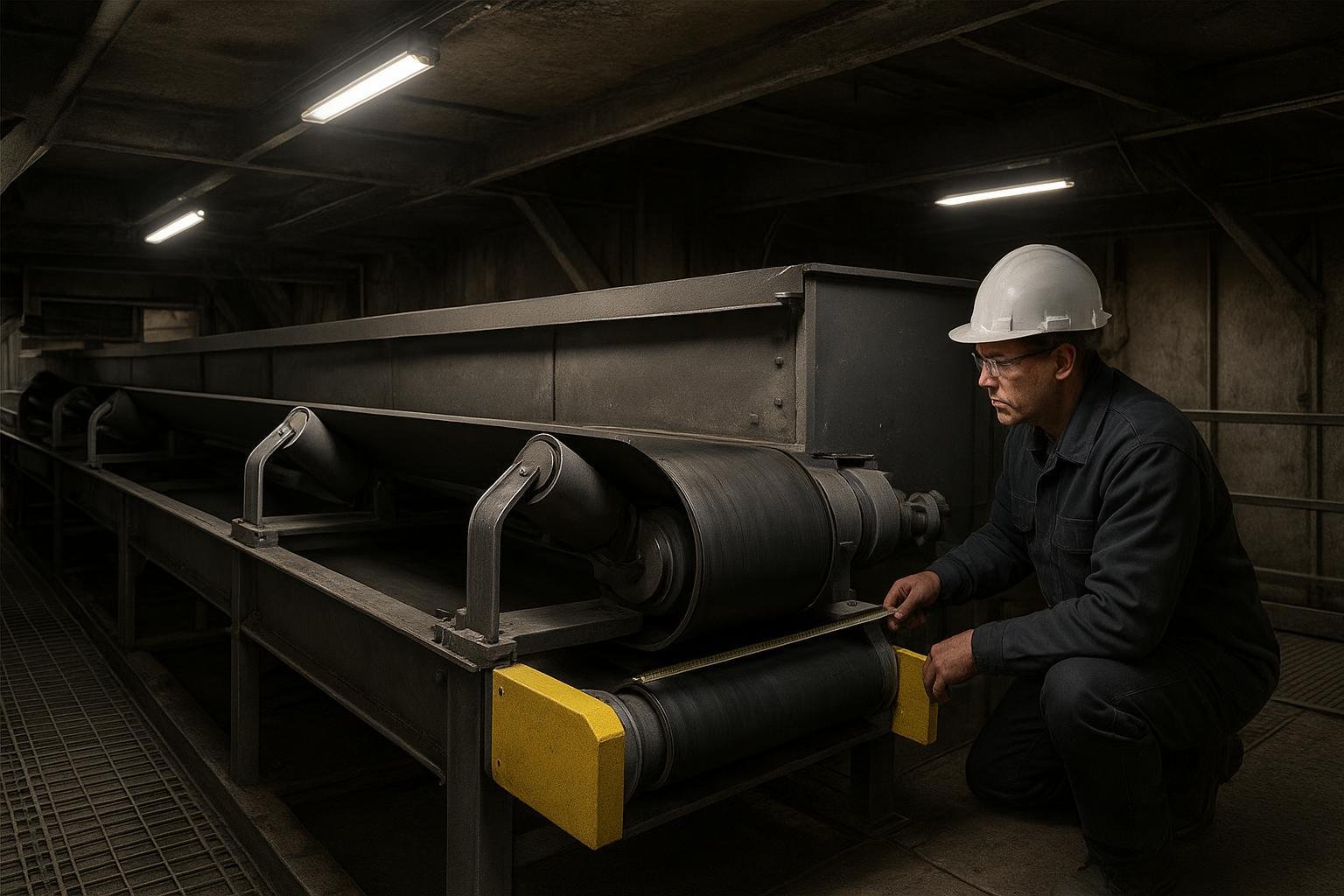
When you have to move bulk material through a shoehorned layout—low headroom, short centers, narrow aisles—every inch counts. This guide distills compact conveyor design into actionable choices: layouts that actually fit, components that shrink envelopes, rules-of-thumb you can defend in a design review, and procurement checks that keep maintenance viable. What would it take to make your next retrofit both compact and serviceable?
Why compact conveyor design succeeds or fails
Tight footprints introduce two conflicting demands: maintain capacity while protecting belt mechanics and maintenance access. You can’t simply shorten transitions, tighten idler spacing, and downsize pulleys without consequences. The art is to concentrate the system while staying inside belt and component limits, providing access for safe service, and containing dust and noise.
A quick note on sources and safety: Standards and many numeric tables live behind paywalls. Where you see “rule-of-thumb,” validate against your belt OEM tables and your plant’s safety engineer (ASME B20.1, CEMA, ISO, OSHA).
Layout patterns that unlock space in compact conveyor design
Well-chosen layouts reclaim envelope without abusing the belt.
- Short, straight runs with under-slung or head-mounted drives reduce external hardware and guarding.
- Vertical change in elevation: consider compact S or Z transfers, helical/spiral towers, or steep-angle belts where material allows.
- Stack runs above/below existing equipment; enclose transfer points so skirtboards and curtains can do the dust work in a short length.
Compact solution matrix (use with site constraints)
| Scenario | Option | Space benefit | Watch-outs |
|---|---|---|---|
| Very low headroom at discharge | Motorized head pulley (drum motor) | Eliminates external motor/gearbox, smaller guards | Heat dissipation, service access planning, motor sizing |
| Short center-to-center | Screw take-up, short transition zones | Minimal take-up tower height | Limited travel; tension drift tolerance |
| Tight horizontal turns | Helical/spiral conveyor | High vertical density | Material rollback, cleaning access |
| Steep inclines | Chevron/sidewall belt | Short footprint for lift | Material compatibility, pulley diameters |
| Crowded loading zone | Slider/impact cradle + close idler spacing | Better sealing in short length | Added drag; selection of wear liners |
Components for compact conveyor design (without regret)
Design choices here make or break reliability in compact systems.
- Belts: Match belt construction to pulley diameters and transitions. Publicly available data is limited, but Fenner Dunlop’s Superfort datasheet shows how allowable pulley diameters scale with construction classes—often hundreds of millimeters even for fabric belts. Confirm required diameters for your exact belt rating and application class using the supplier’s tables; using smaller pulleys than allowed accelerates carcass fatigue. See the directional guidance in the Fenner Dunlop Superfort datasheet (2018).
- Idlers: Low-profile troughing frames and quick-release/slide-in designs help in cramped corridors. Closer spacing in loading zones stabilizes the belt for sealing.
- Pulleys and lagging: Crowns and ceramic/rubber lagging improve tracking and grip with smaller wraps often found in compact routes. Verify minimum pulley diameters for the chosen lagging thickness.
- Drives: Motorized pulleys (integrated drum motors) consolidate motor, gearbox, and bearings inside the pulley, often with high IP sealing. VDG catalogs list sealed drum motors across wide speed/HP ranges and IP ratings up to IP69K for specific series, which can reduce external envelope and guarding. For specs and IP ratings, see Van der Graaf’s Standard and SSV catalogs و SSV IP69K catalog.
Compact-friendly component cues (use as a screening table)
| Component | Compact cue | Trade-off to evaluate |
|---|---|---|
| Belt type | Sidewall or chevron belt for steep lift | Pulley diameter limits; splicing complexity |
| Idlers | Low-profile, slide-in frames | Frame stiffness; sealing clearance |
| Drive | Motorized head pulley | Thermal limits; on-site repairability |
| Take-up | Screw or pneumatic | Limited travel range; load variation |
| Skirtboards | Dual-seal systems with support | Added drag; wear liner maintenance |
Tensioning, transitions, and idler spacing for compact runs
- Tensioning: For short centers, screw take-ups are compact and acceptable where belt stretch is low and load is stable. Gravity, hydraulic, or pneumatic systems need more room but handle load variation better. Allow enough take-up travel to accommodate thermal growth and splice seating. ANSI/CEMA 402 recognizes these take-up types; select based on travel needs and space. See the ANSI/CEMA 402 review context (2019).
- Transitions: Don’t starve the belt of transition distance to “make it fit.” Transition zones should match belt stiffness, trough angle, and tension. Foundations explains the principle and recommends transition idlers where needed; consult OEM tables for distances. Reference the concept in Foundations guidance on transition distance.
- Idler spacing: In compact layouts, you’ll likely tighten spacing in loading zones to control sag and keep skirts sealed. Foundations targets about 1–2% sag under load; return idlers are commonly up to roughly 10–12 ft in many systems, but loading zones are closer. See Foundations on idler spacing and CEMA committee context notes that discuss typical return spacing and skirtboard geometry in meeting materials: CEMA committee agenda set (2019).
Design maintenance access from day one
In tight spaces, “we’ll figure out access later” becomes costly downtime. Bake serviceability into the layout. Think of it this way: if a technician can’t stand, see, and swing a wrench, the design isn’t finished.
Maintenance clearance rules-of-thumb (verify per OEM and site safety)
| Task | Suggested working clearance | Notes |
|---|---|---|
| Idler change (slide-in frame) | 8–12 in lateral clearance at the frame | Based on common slide-in designs; check frame model |
| Belt splice (vulcanized) | Working bay long enough for press platens and clamps; often 6–10 ft straight run | Confirm with the splicing press OEM guidance |
| Scraper service | 12–18 in around primary/secondary cleaners | Allow swing clearance for quick-release blades |
| Pulley/bearing service | Guard removal path + lifting point access | Ensure hoist points are reachable without contortions |
Two maintenance micro-workflows
- Idler swap in a narrow corridor: Isolate and lock out. Drop guards. Use slide-in troughing frame; pull cartridge laterally into the 8–12 in window; swap roll set; reseat; torque per spec; restore guarding. Design implication: preserve that lateral window along the run.
- Emergency belt splice on a short center: Plan a straight run long enough for the press and prep stands. Ensure power and compressed air drops are within reach. Provide lighting and a safe stance platform; don’t force techs to straddle equipment. Design implication: avoid packing structures that block press access.
For installation and recurring maintenance methods, pair your layout with procedure guidance; see the internal resources at Installation manuals و Maintenance guides.
Dust, noise, and safety in confined envelopes
Short runs concentrate turbulence and noise; smart enclosure and safety coverage matter more when you can’t spread out.
- Dust containment: Martin Engineering’s published guidance shows better performance with taller and longer skirtboard enclosures, adding curtains. As a directional benchmark, an enclosure height around 600 mm and length around 3.6 m with three curtains improved containment in typical cases; extend length if turbulence persists. See the 2024 ZKG article reprint from Martin: skirtboard height and curtain count guidance%20Issue%207,%202024.01.pdf). CEMA meeting materials also reference keeping skirtboard distance near roughly two-thirds of the troughed belt width and preserving a free belt edge (~4.5 in) for wandering and sealing—see CEMA agenda notes (2019). Where long duct runs won’t fit, consider insertable/unit dust collectors directly on the enclosure: unit dust collector guidance.
- Safety and controls: Design for lockout/tagout, nip-point guarding, and reachable emergency stop coverage. CEMA’s safety best practice SBP-002 discusses emergency stop application principles and coverage planning—use it to plan pull-cord reach and actuator spacing consistent with plant policy: CEMA SBP-002 E-stop application guide (2022). OSHA’s LOTO framework applies to servicing; coordinate with your safety team and ASME B20.1 requirements. See OSHA reference context: OSHA 1910.269.
For sealing components and belt cleaners compatible with compact enclosures, see Conveyor belt accessories.
Practical examples
Narrow incline in limited headroom (BisonConvey example)
A packaging plant needed to lift granulated fertilizer from a weigh feeder up 14 ft to a rotary packer within a mezzanine where headroom under beams was only 42 in. The team prioritized a compact envelope, easy cleaning, and reliable sealing around the loading point.
- Layout and belt: The solution centered on a 1.0 m-wide modular plastic belt with molded flights to manage the incline at moderate speeds. Modular constructions handle tight sprocket diameters relative to fabric belts, which helped compress the head and tail envelopes. Component availability and sanitation-friendly design supported frequent washdowns between product grades.
- Drives and idlers: A motorized head pulley reduced external drive hardware and allowed a shallow guard profile. Low-profile trough frames under the loading chute maintained sealing while preserving a clear lateral window for idler swaps.
- Dust and sealing: Dual-seal skirtboards with wear liners were specified to keep dust inside a short enclosure; curtain placement followed the “three-curtain” pattern to stabilize airflow.
- Serviceability: The tail section used a screw take-up with easy-to-reach jackscrews and removable panels so crews could access the splice area without dismantling platforms.
To scope and source components for a similar application, engineers referenced the belt options and accessories catalogs to match belt width, flights, and compatible cleaners and skirts. For example components and selection guidance, see Modular plastic conveyor belts and the Conveyor belt selection guide, with consolidated specs in the BisonConvey catalog. The approach is vendor-neutral and can be replicated with equivalent components from qualified suppliers.
Minerals transfer on a short center with low headroom (vendor-agnostic)
A quarry needed to bridge 28 ft between a secondary crusher discharge and a screen feed inside an existing building. Headroom at the discharge pulley was constrained by a truss at 56 in.
- Belt and transitions: A fabric EP belt was chosen with a drive pulley sized to the belt’s minimum diameter class; transition distances were preserved by using transition idlers and shifting the first full-trough set farther from the pulley rather than cutting the distance.
- Spacing and sealing: Carry idlers were tightened in the loading zone to keep sag near 1–2% under design load, which stabilized skirts. Return idlers stayed near typical spacing outside the loading zone to control drag.
- Drive/take-up: A compact screw take-up met the limited travel requirement; a motorized head pulley avoided an offset motor mount that would have hit the truss.
- Dust: A 3.6 m-long enclosure with three curtains improved dust capture at the short loading zone; when moisture rose seasonally, an insertable dust collector was added.
The outcome was a conveyor that fit beneath the truss without violating pulley diameter or transition rules, maintained seal integrity, and preserved access windows for idler changes and scraper service.
Procurement checklist for tight-space conveyors
Use this as RFP language you can paste and tailor. Verify final numbers with OEM tables and standards.
- Provide belt construction, rating, and required minimum pulley diameters for drive/tail and take-up per OEM tables; include transition distance calculations.
- State idler frame profile height and lateral service clearance; specify slide-in/quick-release frames in loading zones.
- Define carry/return idler spacing targets by zone to achieve ≤2% loaded sag at design tonnage.
- Specify drive type and IP rating (e.g., motorized pulley, IP rating per catalog), with thermal limits and service plan.
- Call out take-up type with total travel and adjustment method suitable for short centers.
- Require skirtboard geometry: enclosure height/length, curtain count, free belt edge, and wear liner materials.
- Include dust control method (e.g., insertable collector, cfm target) and noise mitigation expectations for enclosures.
- Guarding and controls: emergency stop coverage plan, pull-cord spacing approach per plant policy and consensus standards; LOTO provisions.
- Maintenance access: minimum clearances for idler swaps, splice press envelope, scraper swing; removable panels/lighting.
- FAT/SAT: verify pulley diameters, idler spacing, enclosure fit, emergency stop function, dust performance under representative flow.
Next steps
Map your constraints, shortlist components optimized for compact conveyor design, and validate transitions and diameters with your belt OEM. For selection references and specs, visit the Conveyor belt selection guide.