If you’re sizing a conveyor, the fastest way to avoid costly rework is to decide up front whether you’ll meet your target throughput by going wider or by running faster. Here’s the short take: pick wider belts when maximum lump size, edge distance, or dust control dictates a bigger cross‑section; pick narrower belts at higher safe speeds when structure and pulleys are fixed and the material tolerates the velocity without spillage or degradation.
Belt width vs capacity: the method (standards at a glance)
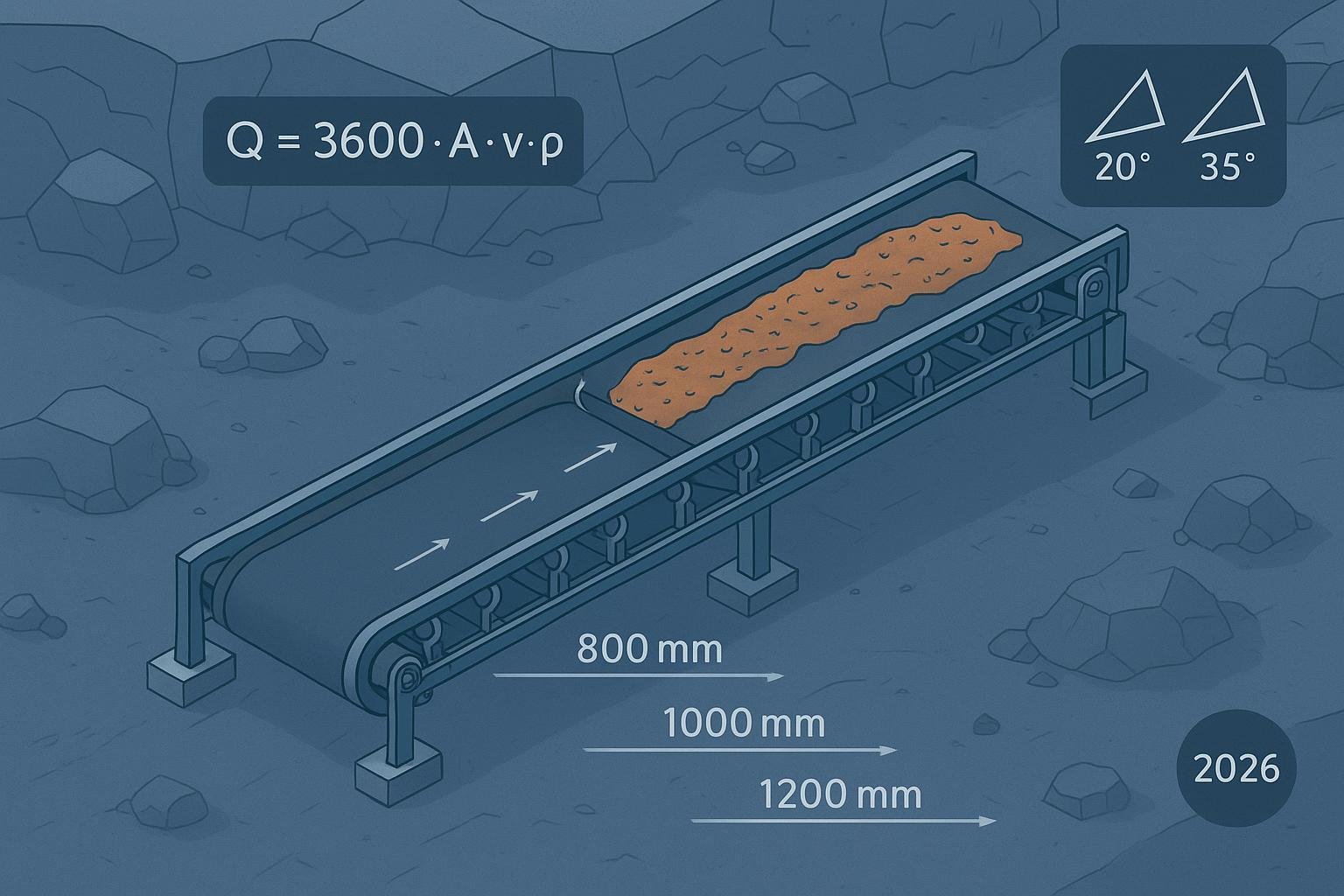
The capacity method used by CEMA, DIN 22101, and ISO 5048 is straightforward: first determine the loaded cross‑sectional area A from troughed‑belt geometry, then compute flow with the fundamental relation Q = 3600 · A · v · ρ (mass flow, t/h), applying a design factor below theoretical when appropriate. See selection steps and speed guidance summarized in CEMA’s Belt Book change pages (2012 corrections).
- A (m²) comes from standard tables/geometry for three‑roll troughs at 20°, 35°, or 45° and the chosen surcharge angle; accessible primers include Phoenix Conveyor Belts Design Fundamentals و Fenner Dunlop’s Conveyor Handbook, which discuss cross‑section and capacity tables used in practice.
- Always verify width against maximum lump size and edge distance rules (often governing minimum belt width even when A seems adequate). The PPI Idler Selection Guide summarizes lump‑to‑width heuristics consistent with CEMA practice and reminds designers to check edge clearance.
- Containment and dust at the load zone are velocity‑sensitive. Martin Engineering’s Foundations guidance on skirtboard geometry and sealing provides practical guardrails for free edge and enclosure length to minimize spillage and dust.
- Power and kWh per ton comparisons should be done with DIN/ISO resistance models (indentation rolling resistance dominates on long conveyors). When in doubt, model both options before you choose wider or faster. For framework and terminology, see DIN 22101 overview (2011).
Note on sources: Capacity tables in standards handbooks are licensed. The example values below are illustrative, aligned to widely used geometry and references, and should be verified for projects using official, current editions.
Worked example matrix for belt width vs capacity (35° trough, v = 2.0 m/s)
Assumptions for this one‑screen comparison: 35° three‑roll trough, surcharge angle consistent with typical bulk aggregates, design factor = 0.85 of theoretical, bulk density ρ = 1.6 t/m³. Cross‑sectional areas A are representative of standard tables discussed in the Phoenix and Fenner Dunlop handbooks. Use these figures as a starting point and verify for your material and idler geometry.
Two spaces below is the example table; SI on the left, approximate imperial on the right.
| Belt width (mm) | Belt width (in) | Cross‑section A (m²) | Speed v (m/s) | Density ρ (t/m³) | Design factor | Capacity Q (t/h) | Capacity (short tph) |
|---|---|---|---|---|---|---|---|
| 800 | 31.5 | 0.067 | 2.0 | 1.6 | 0.85 | 656 | 723 |
| 1000 | 39.4 | 0.102 | 2.0 | 1.6 | 0.85 | 999 | 1101 |
| 1200 | 47.2 | 0.146 | 2.0 | 1.6 | 0.85 | 1430 | 1576 |
| 1400 | 55.1 | 0.198 | 2.0 | 1.6 | 0.85 | 1939 | 2139 |
Caption and method: Q = 3600 · A · v · ρ · (design factor). The capacity formula is summarized by Engineering ToolBox’s conveyor capacity explainer, while A values derive from troughed‑belt geometry as discussed in the Phoenix handbook و Fenner Dunlop handbook.
Sensitivity notes (keep in mind when applying this matrix):
- If you cap speed at 1.5 m/s for dust control, multiply the capacities above by ~0.75; at 2.5 m/s, multiply by ~1.25 — provided your material and load‑zone sealing can tolerate the speed.
- If density is 1.2 t/m³ (e.g., some coals), multiply by ~0.75; if 1.8–2.0 t/m³ (crushed stone), scale accordingly.
- For 45° troughs, A increases; for 20°, it decreases. Re‑run with your trough angle.
Decision tree: widen or increase speed?
- What’s the maximum lump size fraction at your feed? If the largest lumps exceed roughly one‑third of the candidate belt width (typical rule for fines‑rich streams with ~10% lumps) or violate the required edge distance (≈ 0.055·BW + 0.9 in per CEMA practice), choose the next width up or crush before the belt. See the PPI Idler Selection Guide for compiled lump/edge rules.
- Do you have emissions or product‑damage constraints? If yes, cap speed within the envelope for your material class (dust‑sensitive/friable often around ~2.0 m/s or less in many plants) per CEMA’s speed guidance and increase width to reach TPH.
- Is the mechanical structure/pulleys fixed? If yes, evaluate raising speed within your material and idler class limits; keep the width if containment remains stable at the load zone (verify skirt length and sealing per Martin Engineering’s Foundations guidance).
- For long/overland or high‑energy duties, compare kWh per ton for both options using DIN 22101 resistance models; wider isn’t automatically more efficient.
- If incline is steep or footprint is constrained, consider chevron or sidewall designs. Size width for cross‑section stability under incline; expect derating versus flat troughed assumptions (verify with the belt OEM handbook).
Best‑fit picks by scenario
High tonnage with coarse lumps
- When lump size and edge distance govern, width becomes the primary variable. Select the smallest width that safely contains the lumps, then run at a moderate speed to keep the load zone stable. Verify transition lengths and minimum pulley diameters for the chosen carcass.
Dust‑sensitive or friable materials
- Choose wider and slower. Cap v per material class to control dust and degradation. Plan for longer skirtboards, adequate free edge, and sealed transfers. Energy can be managed by choosing efficient idler classes and low‑rolling‑resistance covers.
Retrofit in fixed structures
- If replacing pulleys or stringers is impractical, keep width and raise speed within safe limits. Confirm idler class, spacing (sag), and sealing at higher velocities. Re‑check dust/spillage risk before committing to the change.
Long overland, energy‑sensitive
- Model kWh per ton for candidate widths and speeds. Depending on idler resistance and covers, a slightly narrower belt at an optimized speed may lower energy per ton versus a wider‑and‑slower alternative — but verify with DIN/ISO calculations.
Steep incline or limited footprint
- Use chevron or sidewall belts and size width for stability and sealing at angle. Expect capacity derating from flat‑belt tables and account for transfer design.
Wider vs faster: trade‑off matrix (summary)
| Dimension | Go wider (slower) | Go faster (same width) |
|---|---|---|
| Containment & spillage | Better edge distance and sealing geometry; lower risk at load zone | Higher load‑zone turbulence; sealing more challenging |
| Dust/product degradation | Lower belt speed reduces dust and breakage | Elevated dust and degradation risk on friable materials |
| Energy at duty point | May increase or decrease kWh/t; model per DIN/ISO and consider LRR covers | Can be favorable if resistance model supports it; model to confirm |
| Structural compatibility | Requires longer transitions, possible larger pulleys and idlers | Keeps structure; may need idler class/spacing and skirt upgrades |
| Availability & lead time | Very large widths and special grades can be long‑lead | Uses existing width; motors/VFDs may be available faster |
| Maintainability | Heavier components increase handling burden | Similar components; higher wear rates possible at speed |
Energy and DIN 22101 power check (why kWh per ton decides many ties)
Two configurations can deliver the same tonnage yet differ materially in energy per ton. Indentation rolling resistance often dominates losses on long conveyors; viscoelastic properties of the bottom cover and idler diameter/load matter. Use DIN 22101/ISO 5048 calculations (or OEM tools) to compare candidate width/speed combinations at the duty point before committing. The DIN framework is summarized in English overviews and underpins most engineering software used in the field. See DIN 22101 overview (2011).
FAQ
What belt width do I need to carry a given tph?
- Start from Q = 3600 · A · v · ρ and pick a feasible speed band for your material. Solve for A, then select the smallest width whose standard cross‑section at your trough angle meets A with a design factor, and confirm lump‑size and edge‑distance limits. See CEMA’s change pages for selection flow, and Phoenix’s handbook for cross‑section geometry context.
How does lump size affect minimum belt width?
- As a rule of thumb, belts handling a fines‑rich stream with about 10% lumps should keep the largest lumps below roughly one‑third of the belt width and maintain the standard edge clearance (≈ 0.055·BW + 0.9 in). When this isn’t possible, go to the next width or pre‑crush. The PPI Idler Selection Guide compiles these checks consistent with CEMA practice.
What are typical belt speeds for dusty materials?
- Many plants cap dusty/friable duties around ~2.0 m/s (or lower) to control emissions and product damage; always check recommended bands in your standards and adjust sealing accordingly. Refer to CEMA’s speed guidance و Martin Engineering’s load‑zone guidance.
Wider or faster — which is cheaper to increase capacity?
- It depends on your resistance model and retrofit scope. If widening triggers major structural changes, speeding up within the safe envelope may be cheaper. If dust control, lumps, or edge distance limit speed, widening is often the lower‑risk path. Compare both options on kWh per ton using DIN 22101 before deciding.
Pricing and lead‑time caveats (as of 2026‑01‑27)
Pricing and lead times vary widely with width, carcass type (EP/NN vs. steel cord), cover grade (heat, flame, oil, LRR), and region. Treat any online price bands as indicative only and verify with current vendor quotes. Plan schedule buffers for very wide belts and special grades, which are often built‑to‑order. Include width, strength rating, grade, cover thickness, splice type, and total quantity in your RFQ.
Also consider
If you’re comparing component options as part of this decision, suppliers such as BisonConvey offer conveyor belts across common width ranges along with idlers and pulleys that can be matched to your chosen width and troughing angle. Disclosure: BisonConvey is our product. بيسونكونفي.
Closing guidance
Think of it this way: capacity comes from cross‑sectional area and speed, but reliability comes from respecting lumps, edges, dust, and power. Use the belt width vs capacity method to shortlist candidates, then let material behavior, sealing, transitions, and kWh per ton decide the winner for your site. Validate with your project’s tables and a DIN/ISO power check before you cut steel.