What “autonomous conveyors” really means
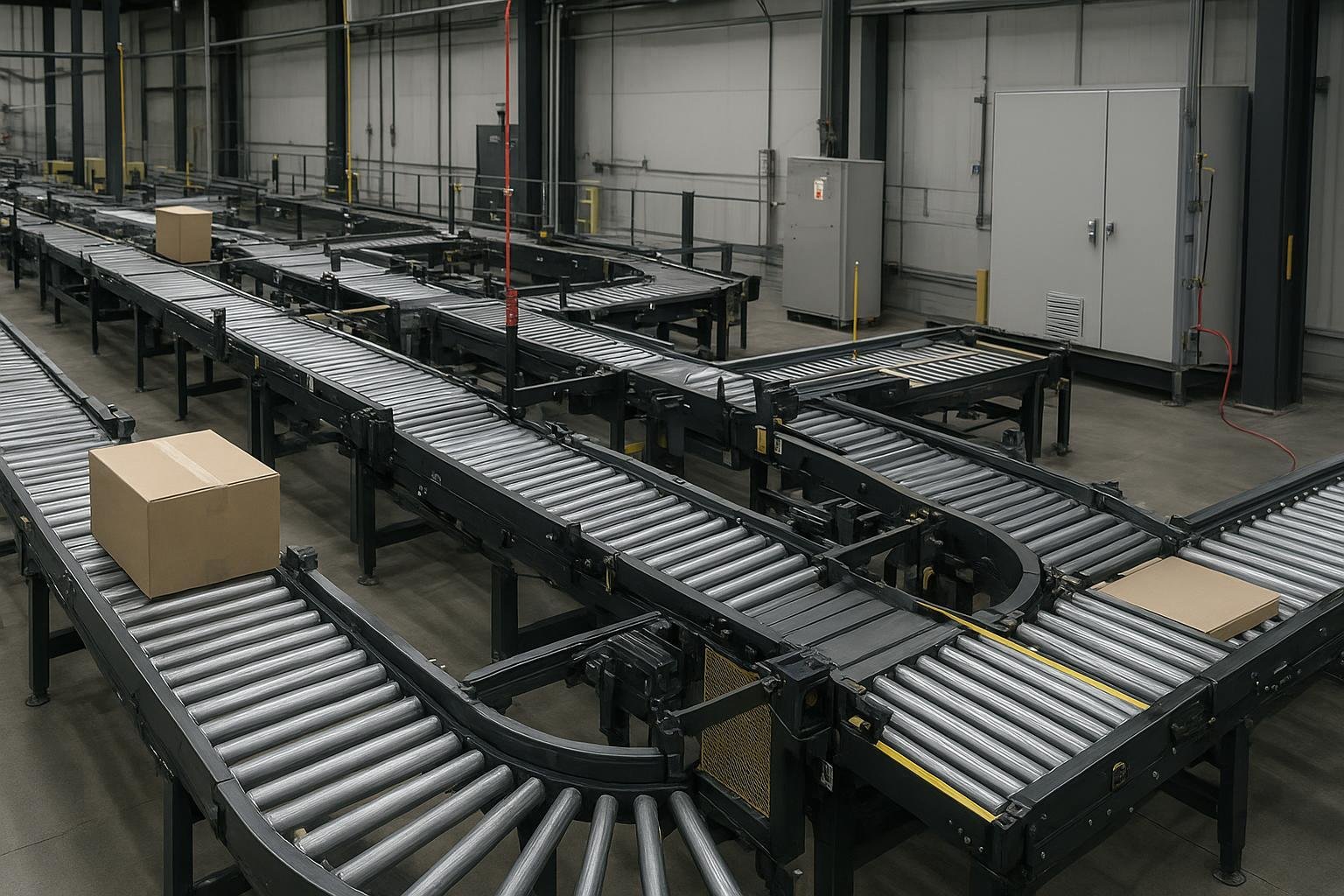
When people say “autonomous conveyors,” they don’t mean robots that roam the floor. They mean fixed-path conveyor systems that can sense, decide, and act locally to regulate flow with minimal operator input. Think of zone control like traffic lights for product flow: each zone “sees” the item, holds it when downstream is full, and releases it when the path clears.
That distinction matters. Autonomous behaviors on conveyors are not free navigation (that’s AMRs/AGVs); they’re coordinated, rule-based actions on a known path. The safety envelope for these actions is defined by industry standards. For design, installation, operation, guarding, and pre-start warnings, see ASME’s current guidance in the ASME B20.1—Safety Standard for Conveyors and Related Equipment (2024 overview). Employers also have regulatory obligations to guard moving parts, position controls, and provide effective startup warnings per OSHA 29 CFR 1926.555—Conveyors.
How the autonomous behavior is built: the technology stack
Autonomous conveyor behaviors emerge from a practical stack of hardware and controls:
- Motorized driven roller (MDR) zones (24/48 V DC) with distributed zone controllers that implement accumulation logic
- Sensors (photo-eyes in each zone) plus optional barcode/RFID or machine vision for identification and routing
- Controllers and interfaces: local zone controllers, PLCs/safety PLCs, and links to WCS/WES/WMS
- Drives: VFDs for belt sections and AC motors for larger modules; MDR drives for unit handling
- Diagnostics: local error signaling, IoT-style condition monitoring, and maintenance alerts
If you want a catalog view of modules that support precise flow control, the unit-handling portfolio from Dematic’s conveyor line is a good reference point: Dematic—Conveyor Products.
What they can do today: operational capabilities
-
Zero-pressure accumulation (ZPA): Each zone holds a single item; upstream zones pause until downstream clears. This prevents contact pressure, protects fragile packaging, and stabilizes merges.
-
Dynamic gapping and release modes: Zone programs (e.g., single-release or train-release) create consistent spacing for barcode scans or sorter induction. You can tighten or widen gaps based on scan/read performance and downstream capacity.
-
Merge and divert logic: Right-angle transfers, steerable wheels, and belt diverters coordinate with scanners and zone signals to send items to the correct lane. The logic runs locally, while higher-level systems (WCS/WES/WMS) supervise routing rules.
-
Energy-on-demand: MDR zones go to sleep when idle and wake as items arrive, reducing unnecessary runtime. Belt sections with VFDs can apply soft starts and speed changes aligned to production windows.
-
Fault isolation and localized recovery: Zone controllers propagate error codes. Maintenance can isolate, lock out, and service a small section without bringing down the entire line.
Safety and functional safety: requirements and validation
Safety isn’t an add-on; it’s part of the design. The current ASME guidance highlights guarding of hazardous points, pre-start warnings for automatically starting systems, and accessible emergency-stop or pull-cord devices from normal working positions—see the ASME B20.1 (2024 overview). OSHA’s conveyor rule spells out guard requirements, start/stop control placement, and startup warnings—see OSHA 1926.555 official text. For standardized safety labels, placement guidance, and best-practice bulletins on e-stops and guarding, consult the CEMA Safety Program.
Autonomous behaviors often depend on safety-related parts of control systems. ISO 13849-1 specifies how to determine and validate the Performance Level (PL) required for each safety function in high-demand/continuous operation—see ISO 13849-1: Safety-related parts of control systems. IEC 62061 offers an alternative SIL-based approach aligned to IEC 61508; many facilities choose one pathway based on legacy and competency.
A quick compliance checklist:
- Identify hazards, conduct risk assessment, and define required PL or SIL for each safety function
- Implement guarding, pull cords, emergency stops, and pre-start warnings consistent with ASME and OSHA scope
- Validate safety PLC logic, interlocks, and presence detection; document test procedures and intervals
- Apply CEMA labels and train operators/maintenance; maintain lockout/tagout procedures and records
Limits and environmental considerations (including bulk handling)
Conveyors are fixed infrastructure. Reconfiguring paths costs time and money, so autonomy shines where lanes are stable and demand is high. In heavy bulk lines—mining, ports, cement—environmental realities drive design choices:
-
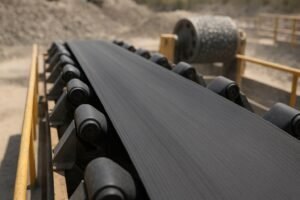
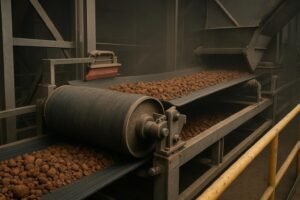
Dust and abrasion: Use belt covers and carcasses designed for wear; add impact idlers at feed points; plan for replaceable wear liners.
-
Heat: Select heat-resistant belt compounds and bearings; avoid exposing sensitive controls to hot zones without protective enclosures.
-
Corrosives: Favor stainless steels (304/316), sealed bearings, and compatible coatings or linings; confirm chemical compatibility with OEM data.
Also consider combustible dust: integrate dust collection, minimize fugitive fines, and follow facility NFPA guidance alongside CEMA practices. These lines often add autonomy in monitoring and interlocks—automated starts/stops, fault isolation, and diagnostics—while the physical path remains stable. Sorters, lifts, and even mobile robots typically interface at endpoints, not midstream, to preserve throughput.
Comparison: autonomous conveyors vs AMRs/AGVs
| Aspect | Autonomous conveyors | AMRs/AGVs |
|---|---|---|
| Throughput | Continuous, high-volume flow on fixed routes; excellent buffering and induction to sorters. Reference analysis in Cisco‑Eagle’s conveyor vs AMR comparison (2023). | Point-to-point transport with flexible routing; practical for moderate volumes and decentralized flows. |
| Flexibility | Fixed infrastructure; changes require planning and budget; excels where lanes are stable. | Reconfigurable fleet and paths; adapts quickly to layout changes and seasonality. |
| Integration | Tight coupling with scanners, sorters, and machinery; zone logic supports energy-on-demand and precise induction. | Integrates with WMS/WES; complements conveyors at endpoints (pick, pack, storage, kitting). |
Decision framework for procurement and reliability engineers
-
Facility stability vs variability: Stable, predictable lanes favor autonomous conveyors; dynamic layouts favor AMRs or hybrids.
-
Product mix and handling risk: Fragile or easily scuffed items benefit from ZPA; irregular or very heavy loads may require specialized modules or alternate conveyance.
-
Environment and skills: Abrasion, dust, heat, and corrosives dictate materials and guarding; your team needs basic controls and sensor maintenance competence.
-
Integration and safety: Define the interface with WMS/MES/WCS; align safety functions to ISO 13849-1 or IEC 62061 and meet ASME/OSHA/CEMA obligations.
Implementation notes, commissioning, and KPIs
Commissioning focuses on outcomes you can verify:
- Set and test ZPA modes (single-release vs train-release); verify sensor alignment and consistent gapping
- Tune merge/divert timings; confirm scan/read rates and downstream induction windows
- Validate pre-start warnings, emergency stops, and pull cords; document tests and sign-offs
Diagnostics and maintainability matter. Track fault codes at zone controllers; schedule inspections for rollers, sensors, belts, and idlers; stock spare controllers and photo-eyes. Good KPIs include line throughput (items/min), accumulation density, energy consumed when zones are active vs idle, mean time between failures (MTBF), mean time to repair (MTTR), and safety incidents/near misses.
Practical micro-example (neutral): In a zero-pressure accumulation feed to a sorter, motorized rollers with distributed zone controllers create consistent gaps, while belt-over-roller sections and idlers carry products through an impact area and into an incline. A supplier like بيسونكونفي can provide belts, idlers, and pulleys for those sections to meet wear and handling requirements. Disclosure: BisonConvey is our product.
Next steps
Define your lane stability, product mix, throughput targets, and safety functions. Pilot autonomy on a contained segment, involve safety early, and validate behaviors against standards before scaling. Then plan lifecycle support—spares, training, diagnostics—so the system stays reliable when the line is busy and the clock is ticking.