A rainy shift shouldn’t bring your conveyor to a crawl. When water, slurry, or oil gets between the belt and drive pulley, traction drops, slip events spike, and motor loads drift. The fix isn’t one magic component—it’s a system approach. In this guide, we share field‑tested ways of improving belt grip in wet conditions, from surface selection and pulley lagging to tensioning, idlers, and maintenance. You’ll also get a simple on‑site protocol to measure gains, plus procurement‑ready spec snippets you can drop into your next RFQ.
What actually drives improving belt grip in wet conditions
Traction at the drive pulley depends on contact pressure, the coefficient of friction (COF) between surfaces, and wrap angle. In wet service, the effective COF falls unless you shed water and maintain pressure where rubber meets lagging. Increasing slack‑side tension to design targets and boosting wrap with a snub pulley are first‑line levers based on Euler’s relation for belt friction. Practical vendor guidance emphasizes verifying slack‑side tension and increasing wrap, particularly when moisture reduces friction—see the 2021 planning notes in the Rulmeca Technical Precautions for Motorized Pulleys and the troubleshooting advice in Martin Sprocket’s Maintenance & Troubleshooting Guide.
Belt covers and textures that help
Cover compound and surface texture strongly influence wet grip, but there’s a trade‑off with wear. Softer rubbers typically provide better compliance on a wet interface, improving real contact area; however, they wear faster in abrasive service. As noted by Rema Tip Top (2024), softer grades around roughly 45–50 Shore A are often used in wet zones, while harder covers (around 60–65 Shore A) suit dry, abrasive duty—choose based on your material and duty profile. Where abrasion is moderate, a slightly softer, micro‑textured or grooved top cover can support traction in the wet.
For deeper reading on material families and selection context, see BisonConvey’s internal overview on conveyor belt cover compounds.
For procurement clarity: specify the outer cover hardness range, oil/chemical resistance where needed, and any required surface texture (e.g., fine transverse grooves). Balance the compound choice with your lagging strategy: a compliant belt surface mated to a high‑friction lagging can outperform a single change made in isolation.
Pulley lagging that works for improving belt grip in wet conditions
Pulley lagging is the most direct way to raise COF at the drive. Two categories dominate wet service: ceramic‑dimple lagging and grooved rubber (diamond or herringbone/chevron).
-
Ceramic‑dimple lagging: Multiple technical guides indicate that studded ceramic faces increase COF and reduce slip in wet or variable conditions. Flexco states that ceramic tiles “increase coefficient of friction between the belt and drive pulley in wet or variable conditions” (2021). See the detailed bonding and selection notes in Flexco’s Ultimate Flex‑Lag Technical Guide (2021). Kinder/DYNA discusses where ceramic faces are preferred in the wet and suggests they can deliver much higher effective friction than rubber under moisture—context and caveats in DYNA Engineering’s guidance (2022). Vendors seldom publish exact wet COF values; validate on site.
-
Grooved rubber lagging (diamond or herringbone): These patterns shed water from the nip, maintaining a drier, higher‑pressure contact. Diamond patterns drain in both directions; herringbone channels flow outward from center to edges, useful for consistent washdown or rain exposure. Pattern selection overviews appear in Luff Industries’ explanation of lagging types.
Quick selection checklist (use alongside field verification):
- Favor ceramic‑dimple on high‑load drives with persistent wet/slurry exposure and when slip has safety or uptime consequences.
- Favor diamond/herringbone rubber where moisture is intermittent, product is delicate, or you want a less aggressive interface.
- Match groove orientation to water path (V‑outward for washdown); request vendor groove geometry matched to your pulley diameter.
For additional context and product families, see BisonConvey’s neutral overview of pulley lagging.
Idlers and sealing for wet service
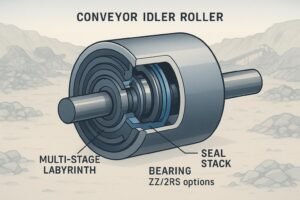
Traction isn’t only about the drive. If water pools, the belt can hydroplane over idlers, hurting tracking and elevating slip risk at the drive. Designs that help include self‑aligning troughing idlers to preserve tracking under slippery loads, impact or rubber‑disc idlers to break up carryback and discourage pooling, and polymer rolls or coated steel for corrosion resistance and lower adhesion. Robust labyrinth or multi‑stage seals protect bearings against moisture ingress during washdown or rain. For authoritative product and design context, see Benetech’s overview of sealed idlers.
Verify it on site with a simple protocol
Treat performance claims as hypotheses until you measure them. Here’s a compact field protocol you can run in a shift. It pairs slip monitoring with coefficient of friction testing so you can quantify the benefit of any change.
- Baseline operations
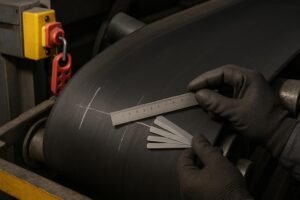
- During a representative wet period, log belt speed (tachometer on the belt), drive rpm, and motor current. Note startup slip events and any visible micro‑slip at steady state. Capture photos of lagging and belt surfaces.
- Spot COF measurements
- Clean sample areas on the lagging and belt. Wet with a consistent spray. Using a portable tribometer (e.g., Heidon H37), record at least 10 static/kinetic readings per surface. Note temperature, contamination, and water application method. See the Heidon H37 brochure (Kett, 2025) for instrument basics.
- Implement the change
- Install the selected lagging (e.g., ceramic‑dimple) or swap belt cover/texture sections. Confirm take‑up setting and, if needed, add a snub to increase wrap angle per the Rulmeca Technical Precautions (2021) guidance.
- Re‑test under matched conditions
- Repeat the logging and tribometer steps in comparable wet exposure. Calculate mean/variance differences in COF, slip events, and current draw. Photograph results for your log.
- Decide and document
- If slip events and current peaks drop, and COF rises, you have evidence for scaling. Store the before/after data in your maintenance CMMS with photos.
Retrofit micro‑example using ceramic lagging
A port conveyor experienced startup slip and short, repeat micro‑slip during squalls. Maintenance had already increased take‑up tension within spec and added a snub pulley, which helped but didn’t eliminate slip. The team chose a surface change.
They installed ceramic‑dimple lagging on the drive and verified that the belt’s top cover had a light grooved texture for better water break‑up. After a 24‑hour cure and safety checks, they ran a back‑to‑back test during similar rainfall. Mean wet COF from portable spot tests increased relative to the prior smooth rubber lagging, and the number of logged slip spikes dropped. Motor current at startup stabilized with fewer peaks, and the belt achieved synchronous speed faster. While numbers vary by site, the pattern matched what vendors suggest for ceramic faces in wet service: higher friction and better drainage at the nip. For product construction context, see BisonConvey’s page on ceramic pulley lagging.
Keep the tone neutral—ceramic is not always the right answer. Where the product is delicate or where residual slip risk persists (e.g., intermittent oil contamination), a less aggressive grooved rubber lagging may reduce the chance of cover scuffing.
Maintenance that preserves traction
Even the best surfaces won’t hold grip if they glaze over with oil or fines. Set a cadence and stick to it, especially during rainy seasons or frequent washdowns. For practical cleaning instructions and inspection points, see MLT’s conveyor cleaning overview and Martin Sprocket’s Maintenance & Troubleshooting Guide.
Checklist for wet‑site maintenance discipline:
- Clean drive and snub pulleys weekly with approved detergents; rinse and dry to avoid film residue.
- Inspect lagging for glazing, loose tiles, or degraded grooves; schedule relagging before smoothness increases slip.
- Verify belt cleaners (primary urethane near 3 o’clock, secondary near 6 o’clock) and skirt sealing to minimize carryback.
- Spin‑check idlers and replace units with water‑contaminated bearings; confirm self‑aligners are functioning under load.
- Re‑confirm belt tension and wrap angle after any change or seasonal shift.
For a consolidated internal reference, see BisonConvey’s conveyor belt maintenance guidance.
Decision matrix and procurement spec snippets
Use this quick matrix as a starting point; validate selections with your on‑site protocol.
| Operating condition | Primary lagging choice | Belt cover/texture | Notes |
|---|---|---|---|
| Persistent rain/slurry, high load | Ceramic‑dimple lagging | Standard hardness with micro‑groove or slightly softer cover if abrasion is moderate | Verify belt cover wear tolerance; confirm bonding method |
| Intermittent wet, moderate load | Diamond or herringbone grooved rubber | Standard hardness; consider fine transverse texture | Orient grooves for outward drainage |
| Oily contamination (intermittent) | Ceramic or polyurethane lagging depending on oil | Oil‑resistant cover compound; textured | Trial on a short section first; monitor for clawing risk |
| Food/washdown, corrosion risk | Grooved rubber or polyurethane | FDA/cleanable cover; fine texture | Favor polymer idlers and sealed bearings |
Procurement spec snippets (drop into RFQs and adjust to your site):
- Drive pulley lagging: Ceramic dimple; alumina tiles ≥92% purity; specify tile coverage level based on duty; bond by hot‑vulcanization or approved cold‑bond per vendor; require adhesion QA results.
- Grooved rubber lagging: Diamond or herringbone pattern engineered for water shedding; vendor to match groove geometry to pulley diameter and duty; rubber compound hardness to match abrasion class.
- Belt cover: Outer cover Shore A 45–55 where wet traction is prioritized and abrasion index is moderate; otherwise 60–65 with micro‑textured surface; oil/chemical resistance per conveyed material.
- Idlers: Self‑aligning troughing sets with multi‑stage labyrinth seals; polymer or coated steel rolls for wet service; impact or rubber‑disc idlers at loading; spacing per class and load.
- Maintenance deliverables: Provide cleaning and inspection checklist; recommended replacement intervals; belt cleaner configuration and compatible detergents.
Next steps
Explore options on BisonConvey’s pulley lagging, belt compounds, and maintenance pages, or contact the team for application guidance.