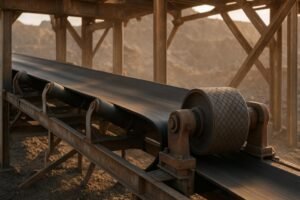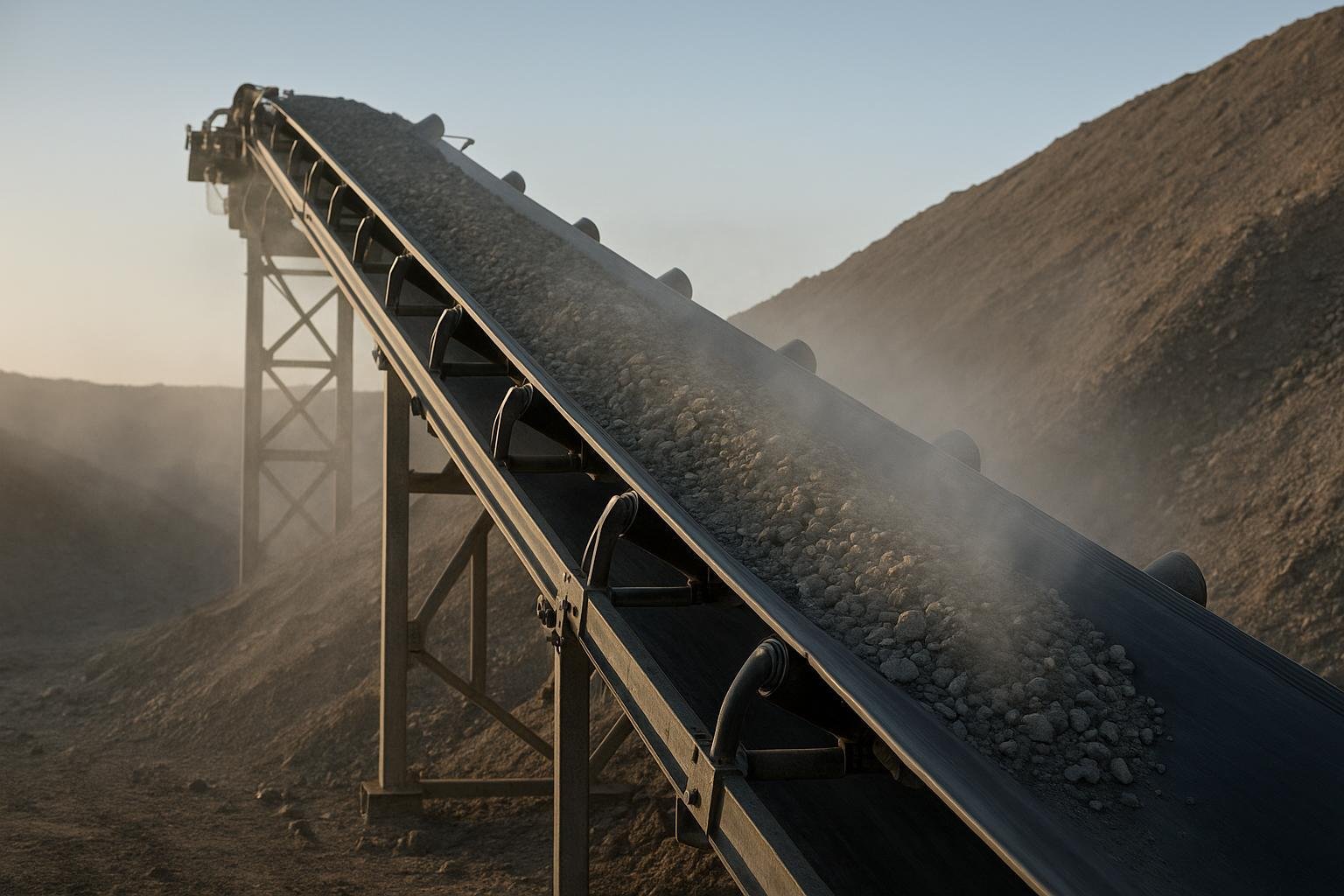
When a plant adds height without space, the conveyor slope angle becomes the silent decision that makes or breaks uptime. Get it right and you move tonnage cleanly with modest power. Get it wrong and you invite rollback, spillage, seal wear, and safety risks. This guide distills conservative, citable practices you can use to select, justify, and commission the right incline—before steel is ordered.
The angles that matter (and why they govern your design)
Three angles underpin every practical decision on conveyor slope angle:
-
Angle of repose: the stable pile angle for a material at rest. It varies with particle size, shape, density, and moisture. It’s a baseline descriptor of flowability used across CEMA and idler OEM literature; see the PPI Idler Selection Guide for how it connects to belt cross-section design and loading.
- Source: the PPI Idler Selection Guide (2021) explains how surcharge relates to repose and containment.
-
Angle of surcharge: the dynamic angle the same material assumes on a moving belt—typically 5–15 degrees less than the repose angle. It more directly governs belt capacity and edge containment on an incline.
-
Angle of maximum inclination: the steepest slope at which your belt will carry that material without rollback under the proposed conditions. CEMA materials describe determining this by trial on a standard test conveyor and note that attainable angle generally decreases as belt speed rises and is affected by sag tension and loading method.
- Context: CEMA Bulk Handling Section materials (2019) summarize definitions and test setups.
Think of repose as “static potential,” surcharge as “dynamic reality,” and maximum inclination as “what actually works on your machine.” Your goal is to choose a conveyor slope angle that respects surcharge, then confirm it in trials.
Practical limits for smooth troughed belts
A simple rule of thumb—useful for first-pass layouts—is to cap smooth, troughed belts near 20 degrees for most bulks. Multiple engineering summaries from FEECO note ~0–20° as the typical range for smooth belts, with steeper angles generally requiring cleats/chevrons or pocketed sidewalls.
- Reference: FEECO Belt Conveyors (PDF) consolidates common ranges and when to step up to steep-incline solutions.
Here’s a conservative, quick-reference table for smooth troughed belts. Adjust downward for moisture, stickiness, large/irregular lumps, and higher belt speeds; validate at site.
| Material category | Typical max incline (°) – smooth troughed belt | Notes and sources |
|---|---|---|
| Coal (bituminous/anthracite) | 15–20 | Repose often 30–40°; surcharge governs usable incline well below repose. Sources: FEECO belt conveyor guide (2022) and Practical Maintenance handbook. |
| Ores/Aggregates/Gravel | 15–20 | Angularity and larger lumps reduce margin; watch edge spillage. Sources: Practical Maintenance; FEECO general guidance. |
| Dry Sand | 15–18 | Free-flowing; can “surf” at speed—keep sealing tight. Sources: Practical Maintenance; FEECO. |
| Whole Grain (corn/wheat) | 15–20 | Free-flowing, dust-prone; verify at operating speed. Sources: FEECO. |
| Cement/Clinker | 13–20 | Hot/irregular clinker trends lower; conservative designs reduce spill. Sources: Practical Maintenance (2018). |
| Fertilizers (urea prills, etc.) | ~13 | Slippery/fragile; derate slope and speed. Sources: Practical Maintenance; industry norms. |
Supporting context: The widely used Practical Maintenance handbook consolidates design cautions across bulk materials and warns against misapplying unit-handling limits to loose bulk; see Practical Maintenance’s bulk conveyor handbook (2018).
What shifts the usable conveyor slope angle
Small choices—belt speed, troughing geometry, idler spacing, and the material’s top size and moisture—add up to big differences in whether a proposed incline runs cleanly.
-
Belt speed: As speed increases, the material’s grip on the belt decreases and edge ejection risk grows. If you’re bumping against spill or rollback on an incline, try reducing speed into the band recommended for your material family before escalating to mechanical add-ons. Lower speeds near transfers also help skirt sealing and dust control; this is a recurring theme in design and troubleshooting literature.
-
Troughing angle and edge distance: 35° and 45° idlers increase cross-sectional area, but they also demand proper edge distance based on surcharge angle to keep fines off the return path. If you push to 45° troughs with coarse lumps, re-check transition lengths and skirt geometry against the dynamic surcharge angle so you don’t “pinch and spill.”
-
Idler spacing and support: Closer spacing (especially through the loading zone and up the first several meters of an incline) reduces sag and bounce, keeping seals tight and limiting rollback. Impact idlers or cradles under the chute stabilize the belt so skirt pressure can be light and uniform. For rules of thumb on skirtboard length and support, see Martin Foundations’ skirtboard guidance.
-
Top size, gradation, and moisture: Large, angular lumps lower your effective surcharge angle and increase overhang at the edges; very fine or damp materials can fluidize or stick. When either extreme shows up, derate your conveyor slope angle several degrees and re-check skirts, liners, and dust control.
Mechanical paths to steeper angles
When space forces a steeper climb, mechanical aids provide the extra shear resistance and containment your material needs.
Chevron/cleated belts (profiled): Appropriate to extend practical inclines for many bulks to roughly 30 degrees by adding transverse profiles that resist downslope shear. FEECO’s guidance places ~30° as a common ceiling for troughed belts when cleats/chevrons are employed. Profiles must be selected for height versus top lump size and checked against OEM speed recommendations.
- Reference: FEECO’s belt conveyor guide outlines when chevrons come into play for steeper inclines.
Corrugated sidewall (pocket) belts: When you need 35–90 degrees (including vertical), corrugated sidewalls with integrated cleats create pockets that carry material without sliding back. Selection hinges on cleat height versus lump size, sidewall height, chute geometry to fill pockets, cross-stabilized base belts, and proper pulley sizing/lagging. For component dimensions and selection context, see an OEM overview like STK Industry’s corrugated sidewall page.
Sandwich/pressure-belt systems: Two belts clamp the material and can move very steeply in compact footprints. They’re specialized, with careful attention to nip forces, wear, and product degradation. Use them when sidewalls or elevators won’t fit and the material tolerates compression.
Micro‑example (neutral): Suppose a brownfield grain conveyor must rise 35 degrees at 50 t/h without expanding the footprint. A practitioner might specify a chevron belt with profiles tall enough to exceed the grain’s typical layer thickness, pair it with 35° trough idlers at conservative speed, and stabilize loading with impact idlers and longer skirts. A supplier like BisonConvey could provide the profiled belt and compatible idlers; you’d still validate speed limits and cleat geometry with the belt OEM before release.
Transfers, sealing, and spill control on inclines
Getting an inclined conveyor to run cleanly is as much about how you load and seal as it is about the nominal angle. Use this compact checklist during design and retrofit:
- Center-load after the transition onto a well-supported belt; avoid loading while the belt is still coming into its trough.
- Size the skirtboard length to contain acceleration; Martin’s rule of thumb is roughly two feet of skirt length per 100 fpm of belt speed (increase where airflow and dust are high), and keep support rigid so seal pressure can be light and even; see Martin Foundations’ skirtboard guidance.
- Use impact idlers or cradles under the chute; set skirt seals with light, uniform pressure using abrasion-resistant materials softer than the belt cover.
- Match chute velocity and direction to the belt; employ curved chutes or rock boxes to reduce turbulence and wear.
Worked example A: Coal at 600 t/h on a proposed 30° smooth belt
A team proposes a 30-degree conveyor slope angle for bituminous coal at 600 t/h on a 1000‑mm, 35°‑troughed smooth belt. First-pass screening against conservative practice says trouble ahead.
- Smooth belts typically top out near ~20° for most bulks; coal is no exception. FEECO’s engineering literature sets ~0–20° as the common smooth-belt band and recommends mechanical aids beyond that. Using 30° without profiles invites rollback and heavy sealing demands. See FEECO’s belt conveyor guide for the smooth vs. steep distinction.
- If operations insists on 30°, you have options: switch to a chevron belt with properly sized profiles; reduce belt speed to improve shear hold; lengthen and stiffen the skirted zone; and verify power for the added vertical lift plus friction from profiles. Expect commissioning to focus on rollback observation and seal wear in the first days.
- If footprint allows, another path is to flatten to ~18–20° and slightly extend run length; reductions in spill and cleanup often offset the added structure over life.
Worked example B: Grain at 35° using a profiled belt
A port retrofit needs 50 t/h of wheat up a 35-degree incline. The team selects a profiled chevron belt and 35° trough idlers at moderate speed.
- Cleat height and spacing: Choose profile height above the expected layer thickness plus a safety margin relative to top kernel/lump size. Too-low profiles won’t resist shear; too-tall profiles can degrade product and hit speed limits.
- Speed: Keep within the belt OEM’s recommended band for that profile height and compound. Higher speeds can reduce effective holding and increase vibration, undermining the 35° target.
- Loading and sealing: Stabilize the loading zone with impact support and longer skirts; align the chute to the belt’s direction to reduce agitation.
- Verification: After installation, run incremental speed trials, map any rollback or spill points, and adjust skirt pressure and seal geometry as needed.
Safety and maintenance essentials for inclined belts
Inclines multiply risk. Two areas deserve non-negotiable attention—anti-runback protection and disciplined housekeeping/inspection.
- Anti-runback protection: Backstops/holdbacks or anti-runback rollers prevent uncontrolled reverse motion during shutdowns or drive faults. See Rulmeca’s anti‑runback roller overview for component function and selection context; coordinate with your drive OEM on torque and placement.
- Inspection and cleaning cadence: Inclines amplify carryback and seal wear. Establish short-interval inspections of skirt seals, impact supports, return cleaners, and lagging. Clean spillage promptly to avoid compaction on the incline structure. A conservative baseline is daily checks during commissioning, tapering to weekly when stable; escalate with sticky materials.
Commissioning checks that prove your conveyor slope angle
Before you call the project “done,” validate the incline under real feed:
- Observe for rollback at the tail during ramp-up, at normal speed, and during controlled stops. If rollback appears, reduce speed and inspect profile efficacy (on chevrons) or derate angle.
- Map spills and dust at the transfer, first skirt meter, and edges up the incline. Small geometry tweaks—seal angle, skirt pressure, or chute alignment—often solve most issues.
- Re-check idler alignment, spacing through the skirted zone, and transition lengths when using 45° troughs or large lumps.
- Document vertical lift and confirm motor power margins with the actual operating angle and friction additions from profiles or sidewalls; verify brake/holdback sizing for worst-case loaded stoppage.
Putting it all together
Here’s the deal: start from conservative, published practice for smooth belts (about 20°), then justify any steeper conveyor slope angle with mechanical aids and verifiable trials. If you need ~30°, chevrons can work with the right profile and speed. If you need 35–90°, corrugated sidewalls or sandwich systems are the reliable path; see STK Industry’s corrugated sidewall overview for component geometry context. In every case, remember that transfer design and sealing determine how cleanly the incline runs day to day.
When in doubt, consult the originals: CEMA’s public materials outline terminology and test context, the PPI Idler Selection Guide explains how surcharge relates to troughing and edge distance, FEECO’s engineering PDF summarizes smooth versus steep-incline practice, and Practical Maintenance compiles hard-won plant cautions.
—
Author: An applications engineer with field commissioning experience on troughed, profiled, and sidewall conveyors in mining, ports, and cement.