If you’re deciding between belt and roller conveyors, you’re really choosing between two different material flow philosophies: continuous supported transport versus zoned, discrete movement. This guide breaks down where each shines, what they cost to own, how they behave day to day, and the safety and energy implications that often tip the scale.
Belt vs. roller at a glance
| Dimension | Belt conveyors | Roller conveyors (gravity & 24V MDR) |
|---|---|---|
| Best use cases | Long or inclined runs; continuous bulk (ore, grain, cement) and packages that need full support; curves and profile belts for steep angles | Flat‑bottom totes/cartons; short transfers (gravity); modular warehouse/parcel lines with zero‑pressure accumulation (24V MDR) |
| Pros | Handles bulk and irregular/fragile bases; accepts inclines/curves; gentle, fully supported surface; high throughput over distance | Low power (gravity) or on‑demand (MDR); modular zones and easy reconfiguration; excellent accumulation; simpler component swaps |
| Cons | Needs tracking/tension and cleaning; dust/carryback risk if unmanaged; continuous drive uses power even when lightly loaded | Needs flat, stable bases; irregular/sticky items can stall or jam; curves/steep inclines are limited; powered rollers add electronics |
| Maintenance | Proactive: tracking, idler/roller health, scraper wear, tension, housekeeping | Modular: swap rollers/zones, keep sensors/controls clean, standard checks for bearings and drive cards |
| Energy | Dominated by belt flexing on idlers and rolling components; alignment and low‑drag components matter | Gravity: no power; MDR: zones run only when loaded, reducing idle consumption |
| Safety | Guard nip points, use E‑stops (e.g., pull‑cords where appropriate), strict LOTO | Fewer exposed spans per zone but same rules: guard pinch points, accessible E‑stops, LOTO for service |
| Cost/TCO | Higher initial on long/heavy‑duty builds but strong lifecycle ROI for high throughput and labor savings | Gravity is lowest cost for simple runs; MDR has higher upfront than gravity but pays back via accumulation control and energy savings |
When a belt conveyor is the right answer
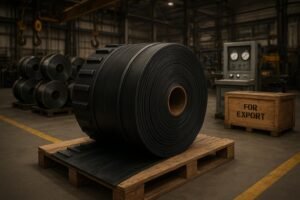
Belted systems are the workhorses for continuous transport—especially when your material doesn’t sit nicely on rollers. Bulk ores, coal, grain, cement clinker, fertilizers, and fine powders benefit from a supported surface that contains and guides flow. In unit handling, belts also excel with small parts, soft packages, or items with irregular or fragile bottoms that could snag or tip on rollers. Belts accommodate inclines and declines and can include curved modules for compact layouts. Mainstream OEM resources outline how belted curves and profiles expand layout options, and how profile or sidewall belts extend incline capability beyond standard flat belts, as summarized in Dorner’s 2025 overview: guide to conveyor belts and applications (2025).
Throughput over distance is another reason belts dominate mines, quarries, and ports. They carry high tonnage at steady speeds with predictable control. The continuous surface also reduces point loads and vibration, which is useful for fragile packaging or materials prone to damage.
What deserves attention is maintenance that preserves efficiency. Tracking and tension are non‑negotiable. Misalignment, fouled idlers, or poor scraper settings increase drag and wear and can raise power draw. Belt energy losses are governed by well‑understood mechanisms—indentation rolling resistance in the belt, idler/bearing drag, and flexing over pulleys—discussed in engineering literature like the Beltcon conference papers: power and resistance mechanisms in belt conveyors (2024). Dust and carryback also need controls; skirts, sealing, and primary/secondary scrapers help keep material on the path and off return rollers.
When roller conveyors win (gravity and 24V MDR)
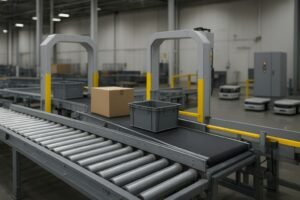
Roller platforms are purpose‑built for discrete, flat‑bottom items: cartons, totes, trays, and many pallets. For short, simple moves, gravity rollers are unbeatable on simplicity and cost. For complex intralogistics—e‑commerce, parcel, and fulfillment—24V motor‑driven rollers (MDR) enable zero‑pressure accumulation, merges, and precise buffering. MDR runs by zone with sensors, so only occupied zones move, which delivers high throughput with gentle stops and starts. Hytrol’s engineering blog explains the benefits of 24V platforms versus conventional drives, especially for accumulation and reduced idle power: choosing 24V live roller: advantages and use cases (2024). For technical speed ranges and zone concepts, refer to the PulseRoller catalog (2024).
Limits matter. Irregular or sticky items can bridge, stall, or tip on rollers; you may need a belted section, trays, or carriers for those SKUs. Steep inclines and tight curves are not the domain of rollers. Gravity needs safe slopes; powered rollers climb only moderate grades with friction‑friendly bases and appropriate drive ratios.
Maintenance in practice: what changes day to day
Maintenance isn’t just a budget line—it defines uptime. Belts respond best to disciplined preventative care: daily housekeeping and visual checks, with periodic inspections of belt edges, tracking, idlers and returns, take‑ups, and scrapers. Keep return rolls free‑spinning and remove carryback. A practical overview from PRC Industrial outlines inspection cadence and common failure modes: conveyor belt maintenance guide (2024).
Roller systems concentrate effort on modular swaps and cleanliness. Keep rollers free‑spinning and aligned, verify sensor health and zone logic on MDR, and protect power supplies and cards from dust and moisture. There’s no belt tracking or tensioning, which often shortens troubleshooting.
Energy and sustainability: how they differ
A long belt is like a highway that’s always open—great for throughput, but it still “costs” to keep it rolling smoothly. Steady‑state power is dominated by the physics of a loaded belt flexing over idlers and components rolling under load. That’s why alignment, low‑drag idlers, optimized cover compounds and thickness, and minimizing parasitic contact (for example, properly adjusted skirts) pay off. The mechanisms and mitigation levers are covered in engineering sources like the Beltcon 2024 paper: belt conveyor power and resistance mechanisms (2024).
MDR behaves more like smart traffic lights—sections wake up only when there’s a “car.” Gravity lines consume no electrical power, and 24V MDR activates only when zones are occupied, which reduces idle draw versus continuously driven lines. For operations that spend significant time under partial load or intermittent flow, this on‑demand behavior can materially lower energy use while improving control, as discussed in Hytrol’s 2024 engineering blog: 24V live roller advantages and energy behavior (2024).
Safety and compliance you can’t ignore
Both categories fall under ASME B20.1 and OSHA 1910 requirements. The fundamentals don’t change: guard nip and pinch points, provide accessible emergency stop means appropriate to the hazard and access (for example, pull‑cords on long exposed runs), and enforce lockout/tagout (LOTO) during service. The 2024 edition of ASME B20.1 updated provisions around emergency stop device identification and maintenance guidance. See the overview from ANSI: ASME B20.1‑2024 safety standard for conveyors (Dec 2024). Always integrate guarding and E‑stops into the mechanical design—not as an afterthought—and never bypass interlocks for convenience.
How to choose: a practical checklist
- Material form and base: Bulk, fines, sticky, fragile, or irregular bases → lean belt. Flat‑bottom cartons/totes/pallets with accumulation needs → lean roller/MDR.
- Distance and geometry: Long runs, steep climbs, or curves → belt. Short, modular cells with branching → MDR/rollers.
- Throughput and control: Continuous, high‑tonnage → belt. Zoned accumulation, buffering, and merges → MDR.
- Environment and housekeeping: Heavy dust/abrasion → belt with robust cleaners/sealing and high‑quality idlers; keep MDR electronics protected if used nearby.
- Energy profile: Mostly continuous, high utilization → belt optimizations (low‑drag idlers, alignment). Intermittent/partial load → MDR’s on‑demand zones.
- Maintenance culture and spares: Strong PM program and belt experience → belt is fine. Prefer plug‑and‑play component swaps and modularity → MDR/rollers shine.
- Budget and TCO: Gravity roller is lowest‑cost for simple short runs; MDR carries higher upfront but reduces idle energy and offers precise control. Large‑scale bulk lines justify belt capital via throughput and labor efficiency.
Hybrid layouts and edge cases
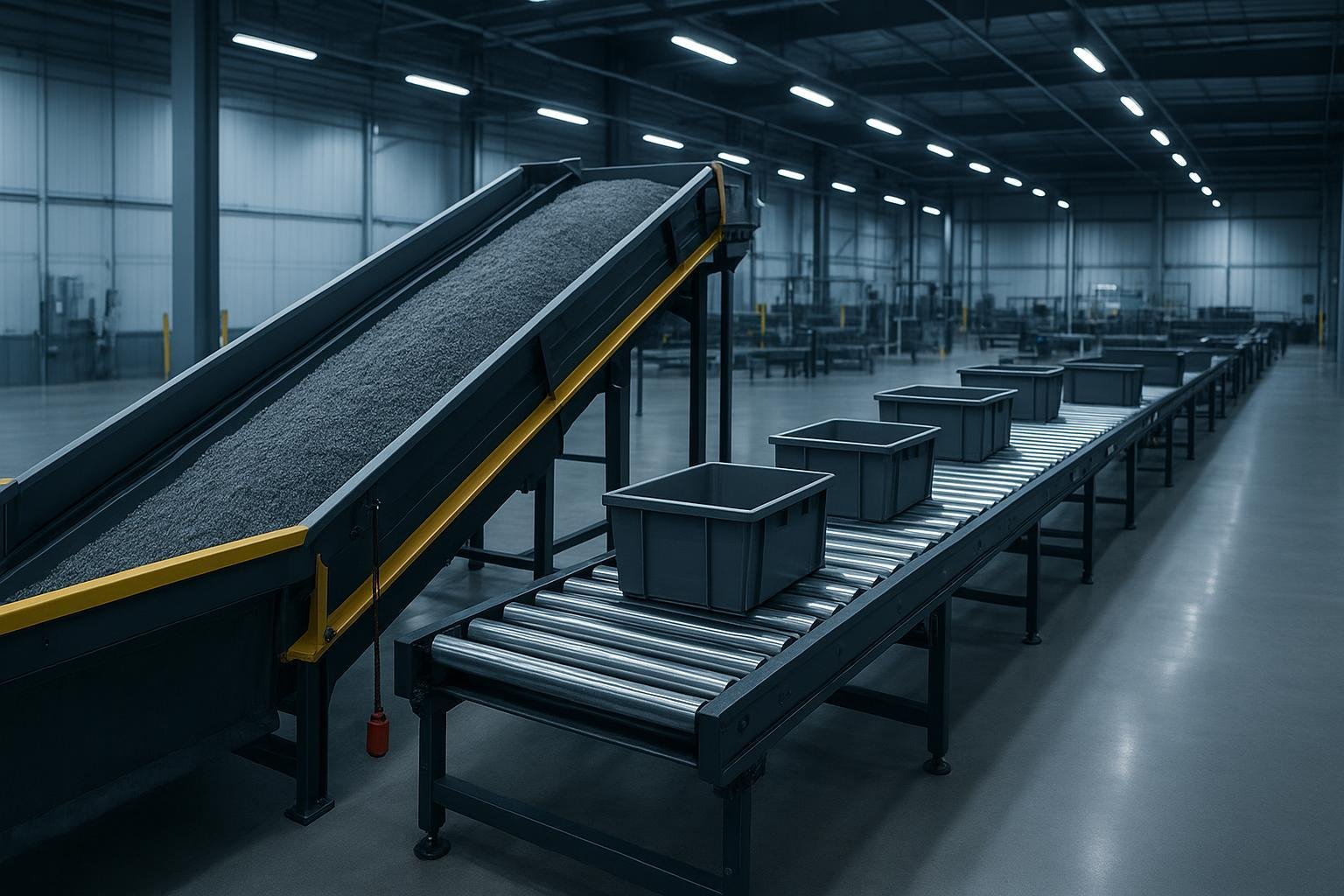
Many plants combine both. A common pattern is long‑haul belts feeding packaging or sortation zones built on MDR. In food and fragile packaging, belts may dominate for gentle handling, with short roller spur lines for consolidation. In mining and ports, belts handle the trunk haul; small gravity roller sections might bridge manual workstations. Edge cases include irregular or soft packages in e‑commerce where a belt “carrier” section between MDR segments stabilizes product; steep mezzanines where profiled belts are safer and more controllable than pushing the limits of roller traction; and high‑temperature or corrosive environments where belt compounds, idlers, pulleys, and enclosures must be specified for the chemistry and heat.
Also consider (brand disclosure)
Disclosure: BisonConvey is our product. If you’re evaluating belted solutions for bulk handling or supported‑surface transport, you can explore belts (steel cord; EP/NN; chevron; sidewall) and compatible idlers/pulleys engineered for harsh environments at BisonConvey: premium conveyor belts and components. This mention is provided for relevance; compare specifications across multiple vendors for your application.
Wrap‑up
There’s no single “winner.” Belts deliver continuous, gentle transport over distance and elevation; rollers—especially 24V MDR—excel at discrete, modular flows with accumulation and on‑demand energy. Map your material form, geometry, duty cycle, and maintenance culture to the strengths above, then validate with site‑specific engineering and safety reviews. When in doubt, pilot a short section under real loads—your uptime data will make the decision obvious.